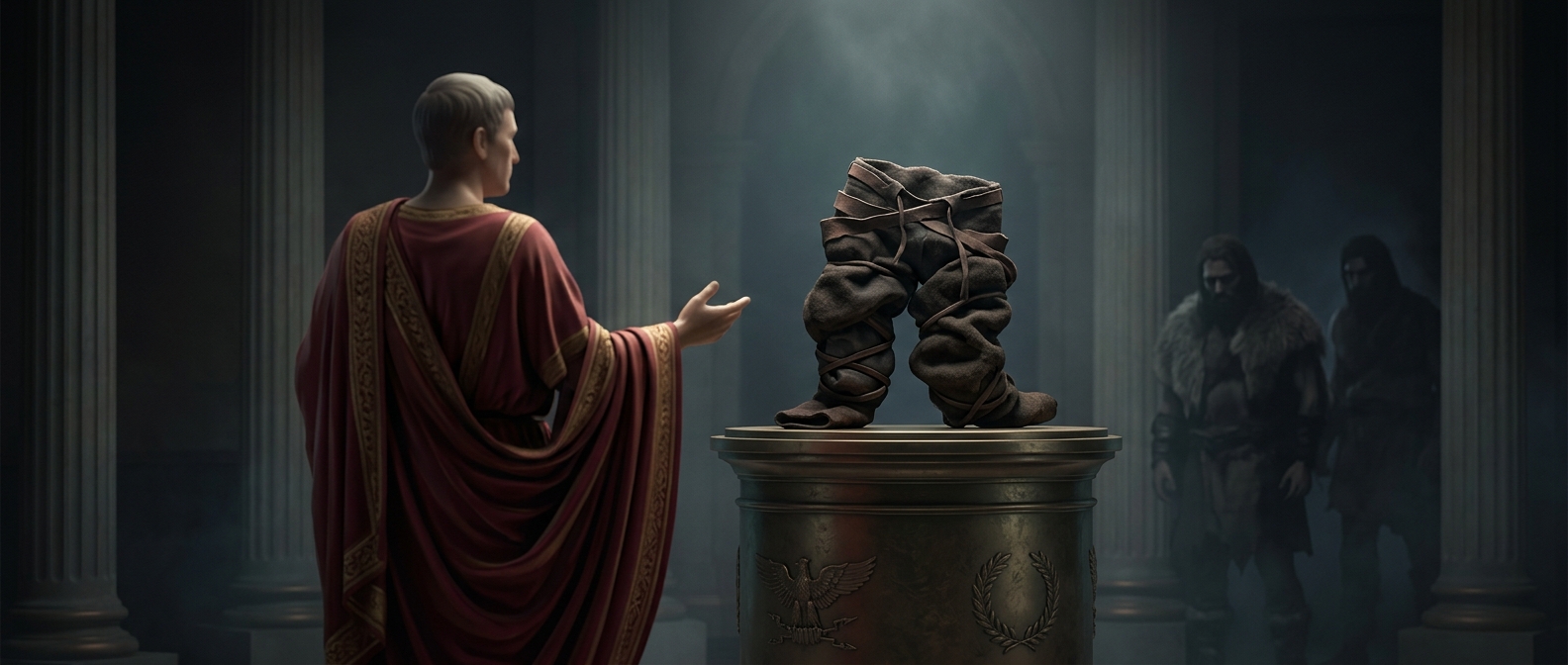
A garment that drew a cultural border
For many Roman elites, trousers were not simply an unfamiliar cut of clothing. They were associated with peoples beyond the empire’s cultural center, especially communities in colder regions where leg-covering clothing was practical. Romans often described such outsiders as “barbarians”—a label that expressed Roman ideas about civilization as much as it identified a person’s origins.
The toga, by contrast, was a conspicuous Roman garment. Draped around the body rather than pulled on like trousers, it was associated with public standing and civic life. Wearing it could signal that a man belonged in the Roman world, while trousers could suggest that he belonged to a different one.
Practical clothing, political meaning
This contrast was partly a matter of setting. A toga was cumbersome for riding, marching, or working in cold weather; trousers offered more protection and freedom of movement. Roman soldiers and officials operating in frontier regions could find local clothing useful, even while Roman observers at home treated it as culturally suspect.
That tension explains why objections to trousers could become more than fashion criticism. If a garment was taken as a sign of foreignness, wearing it in Rome could seem to blur the boundary between Roman identity and the peoples the empire ruled or fought. Emperors at times restricted trousers in the city, turning an everyday choice into a statement about which customs belonged in the capital.
The boundary was never purely practical
Roman clothing was not uniform, and the toga was not an everyday outfit for every Roman. Its importance lay in what it represented in formal public life. Trousers could be sensible on a frontier and still appear improper in the capital because Romans judged clothing not only by comfort, but by the identity it announced. A practical garment became politically charged when it looked like an adoption of the people Rome called foreign.