Why Number Could Have a Gender
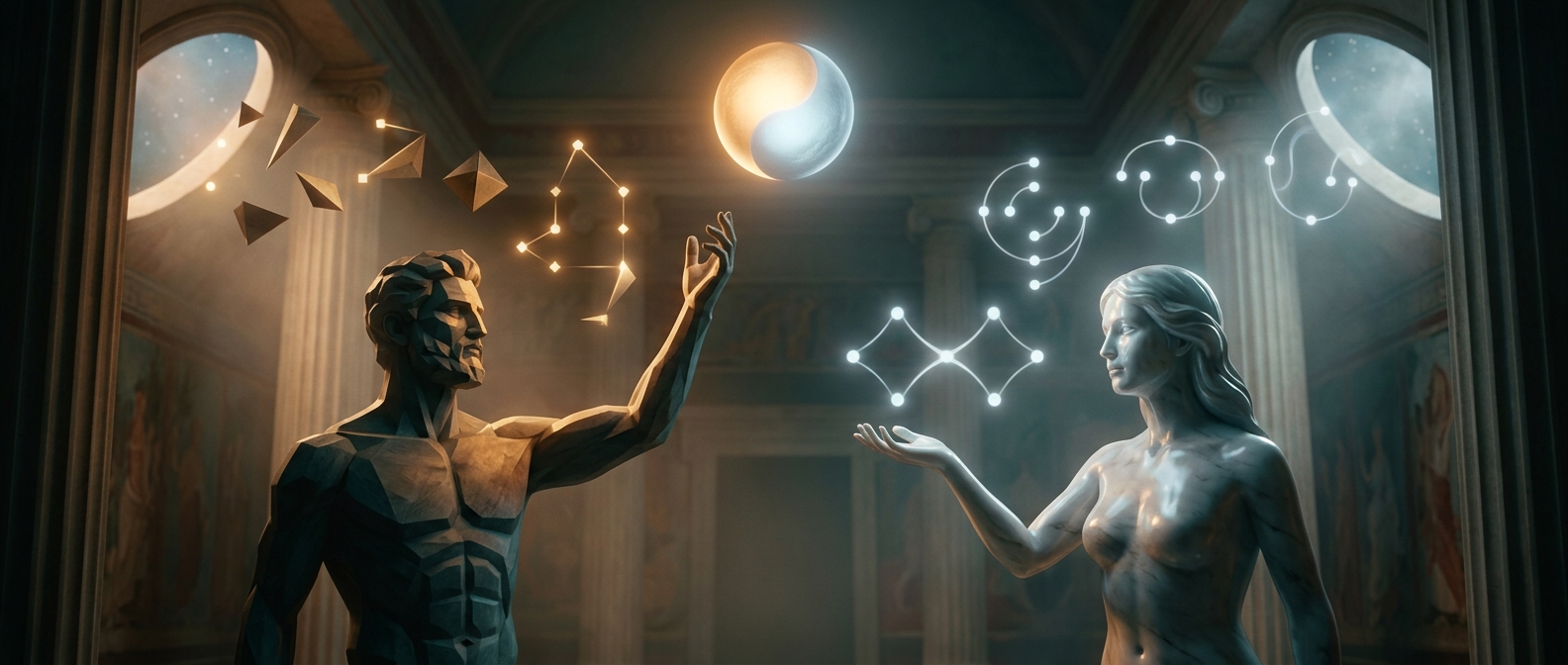
For Pythagoreans, numbers were not merely tools for counting. They were building blocks of an ordered universe, so a number’s mathematical properties could carry moral and cosmic meaning. In that symbolic scheme, odd numbers were linked with masculinity, strength, and divinity; even numbers with femininity, weakness, and the earthly.
The contrast drew on a visible difference in how the numbers behave. Arrange an odd number of counters in a row and one remains at the center when the rest are paired. With an even number, every counter can be matched, leaving no single one apart. Pythagorean thinkers could read such patterns as signs of different qualities—not as claims about how men and women actually function, but as a way to sort the world into paired opposites.
A Mathematical Pattern Became a Worldview
This kind of reasoning belonged to a broader habit of treating opposites—such as limited and unlimited, light and dark, or male and female—as basic principles of reality. Number symbolism made those abstractions feel tangible: an arrangement of counters could stand for a distinction between order and disorder, or the divine and the material.
The associations were therefore more than decorative labels. They helped turn arithmetic into a language for explaining how the cosmos was structured. The same number could be both a quantity and a miniature model of the world.
That is why odd and even numbers could acquire gendered meanings without describing bodies: the symbolism came from the pattern the numbers made, then extended that pattern into a larger account of nature.