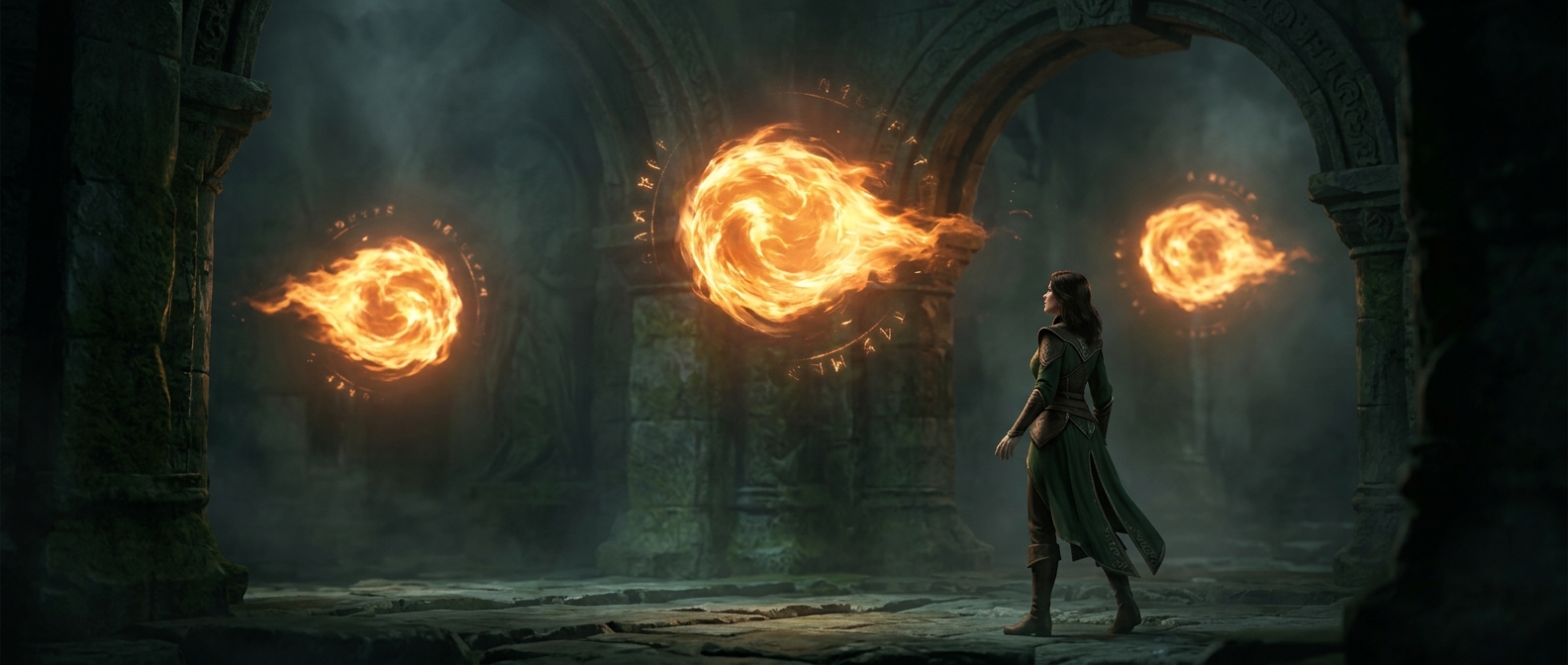
A Fireball Is an Area Rule, Not a Fluid Simulation
A tabletop fireball is usually resolved by asking which spaces fall inside its defined area—not by modeling how hot gas, pressure, and flame would move through a room. The grid turns a complicated physical event into a clear game procedure: mark the affected spaces, then determine who or what is in them.
That distinction matters at a wall. In real life, a blast could reflect, flow around obstacles, or send heat and debris into places its initial path did not reach. A rules-defined area does none of those things unless the game explicitly says it does. The wall may block movement or sight, but it does not automatically redirect the spell’s effect.
Why the Simplification Changes Play
Simulating every surface would mean tracking materials, angles, airflow, and changing temperatures—far more work than most turns can support. A fixed area keeps the spell quick to resolve and gives players a dependable way to judge risk. The wizard can plan around the stated boundary rather than guess how a fictional blast might rebound.
That predictability is a design tradeoff: the spell behaves like a marked zone on the map, not like a miniature explosion simulation. A wall can still matter if the rules give it a specific effect, but players should not assume ordinary fire physics fills in unstated consequences. The result is less realistic, yet easier to adjudicate consistently when every square and every turn counts.