How a swell travels without carrying the sea along
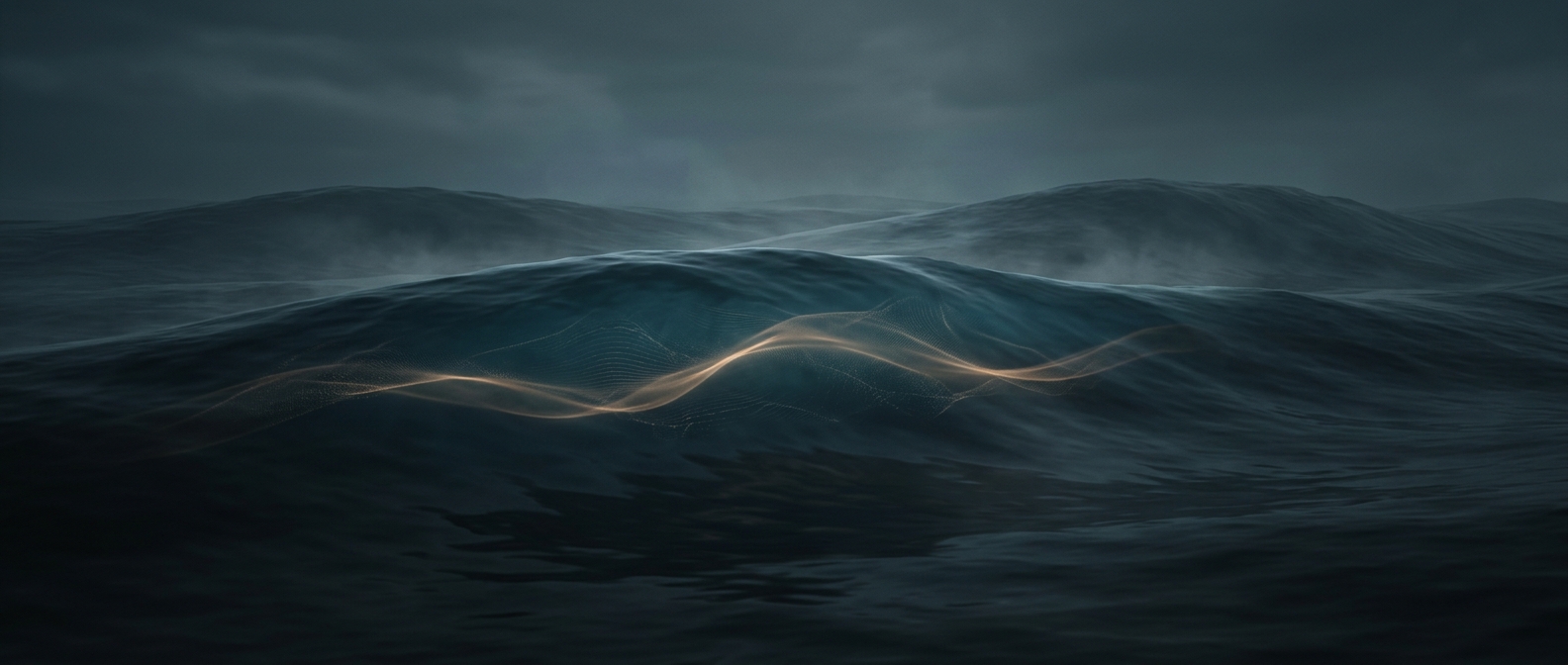
A deep-water swell is a moving pattern, not a traveling wall of water. Wind transfers energy to the ocean surface, creating crests and troughs. As the pattern advances, each water parcel is pushed into a small orbit by the changing pressure and motion around it. The parcel rises, moves forward, sinks, and moves back, ending near where it began as the wave passes.
The key is timing: neighboring parcels begin the same motion one after another. Their local movements pass the wave’s energy onward, much as a stadium crowd’s wave travels around the stands while each person mostly stays in place. The water’s motion is real, but the swell’s forward progress comes from energy moving through that water—not from a matching stream of water traveling with it.
The seabed changes the parcel route
In deep water, the circular motion fades rapidly with depth, so the swell’s influence is concentrated near the surface. As waves approach shallow water, the seabed interferes with those orbits. They flatten, the wave slows, and its shape changes; eventually the wave may break, releasing energy into turbulence and currents.
The parcel analogy is not exact: real waves can produce a small net drift, and breaking waves can move substantial water toward shore. But for a passing deep-water swell, the striking distinction holds: a distant storm can send energy across an ocean without transporting a comparable body of seawater with it.