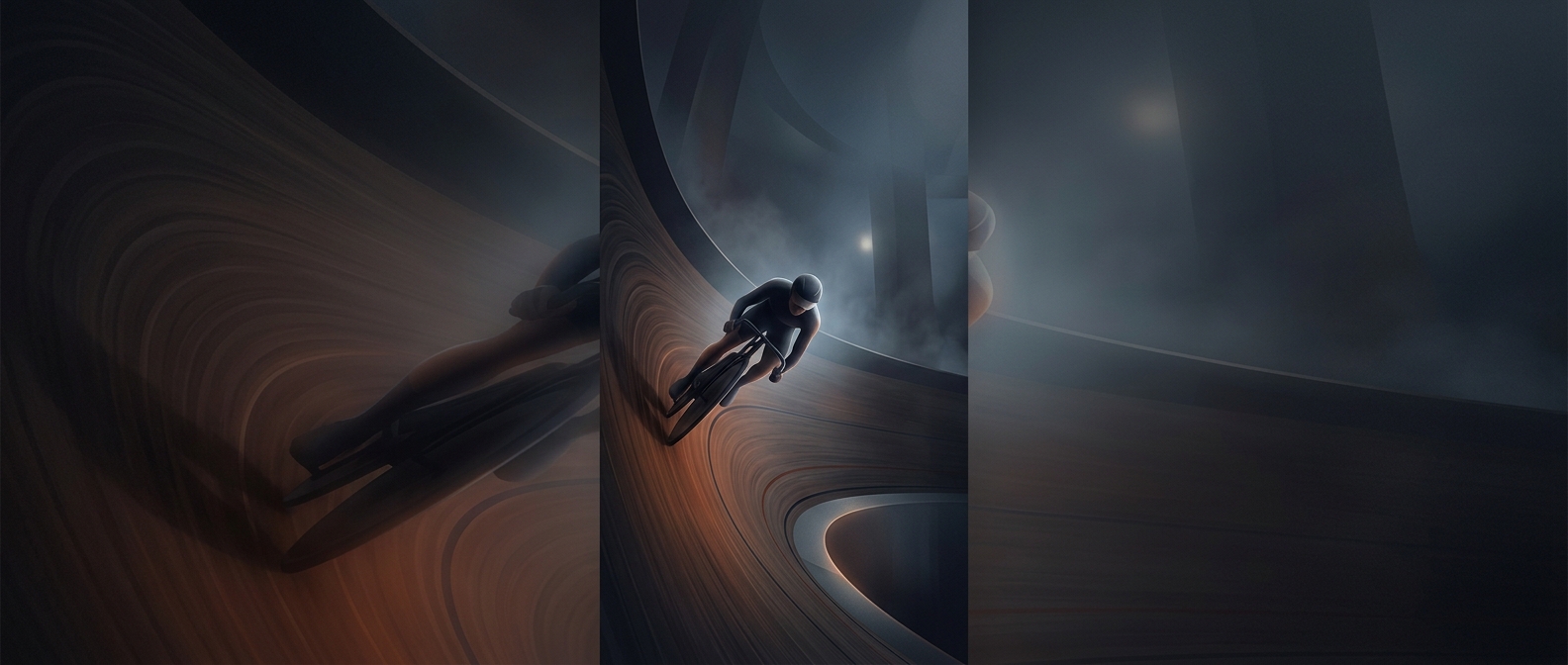
How a banked bend turns a rider
A cyclist rounding a curve must continually change direction. That inward change requires a force toward the center of the turn; without it, the bike would keep moving along a straighter path and drift outward relative to the curve.
On a flat track, tire grip has to provide most of that inward force. A banked track changes the geometry. The surface pushes up on the tires, and because the surface is tilted, part of that push points inward. At racing speed, that inward component can do much of the work of turning the bike, rather than leaving the tires to supply it through grip alone.
Why the banking is so dramatic
The faster a rider goes, the more sharply the rider’s direction changes over a given curve, and the greater the inward force needed. A steeply banked bend lets the track’s push contribute strongly to that force. The rider and bike lean with the slope, keeping the tires planted while the turn is made.
The banking also affects which line a rider can use. A higher line around the bend has a wider curve, so it takes a different speed to match the track’s angle comfortably. Riders adjust their path and pace together: choosing a line is not just about distance, but about how fast they can carry momentum through the turn.
That is why a velodrome’s towering curve is functional, not theatrical. It lets riders keep speed through a bend without relying on tire grip alone to redirect them.