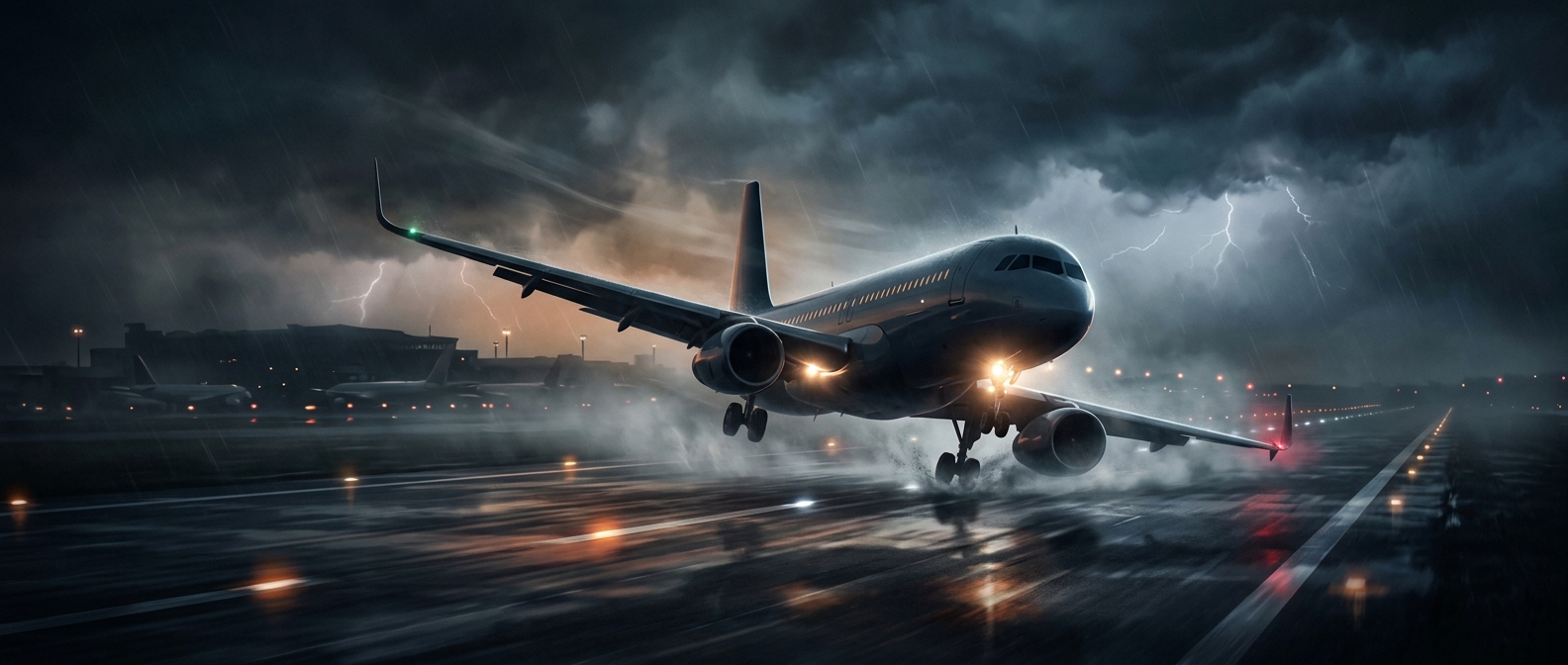
Why a crosswind makes a straight approach look sideways
A plane is moving through the air, but the runway is fixed to the ground. If wind blows across the runway, it pushes the aircraft sideways while it travels forward. The pilot therefore has to aim the aircraft partly into the wind so its combined motion—forward through the air and sideways with the wind—carries it along the runway’s centerline.
That angled appearance is called a crab. It is not a skid: the aircraft can be moving straight over the ground even while its nose points off to one side. The stronger the crosswind, the more nose angle may be needed to cancel the drift.
The final change is about the wheels
A crab works well in the air, but the landing gear is built to touch down aligned with the runway. If the plane landed while still angled, its tires could meet the pavement sideways, creating unwanted force on the landing gear. Near touchdown, the pilot uses the rudder—the control that turns the nose left or right—to bring it parallel to the runway, while using the ailerons, which control roll, to keep the wings level and manage drift.
Pilots may also use a “wing-low” approach, lowering the upwind wing and applying opposite rudder to keep the nose aligned. The exact technique depends on the aircraft and conditions; gusts can make the needed corrections change from moment to moment.
The key is that the plane must satisfy two alignments at once: its ground track must stay over the runway, and its wheels must meet the pavement pointing down it. That is why a crosswind landing can look like a sideways walk in the air, followed by a brief, precise correction at the runway.