How a mountain can hide a loop
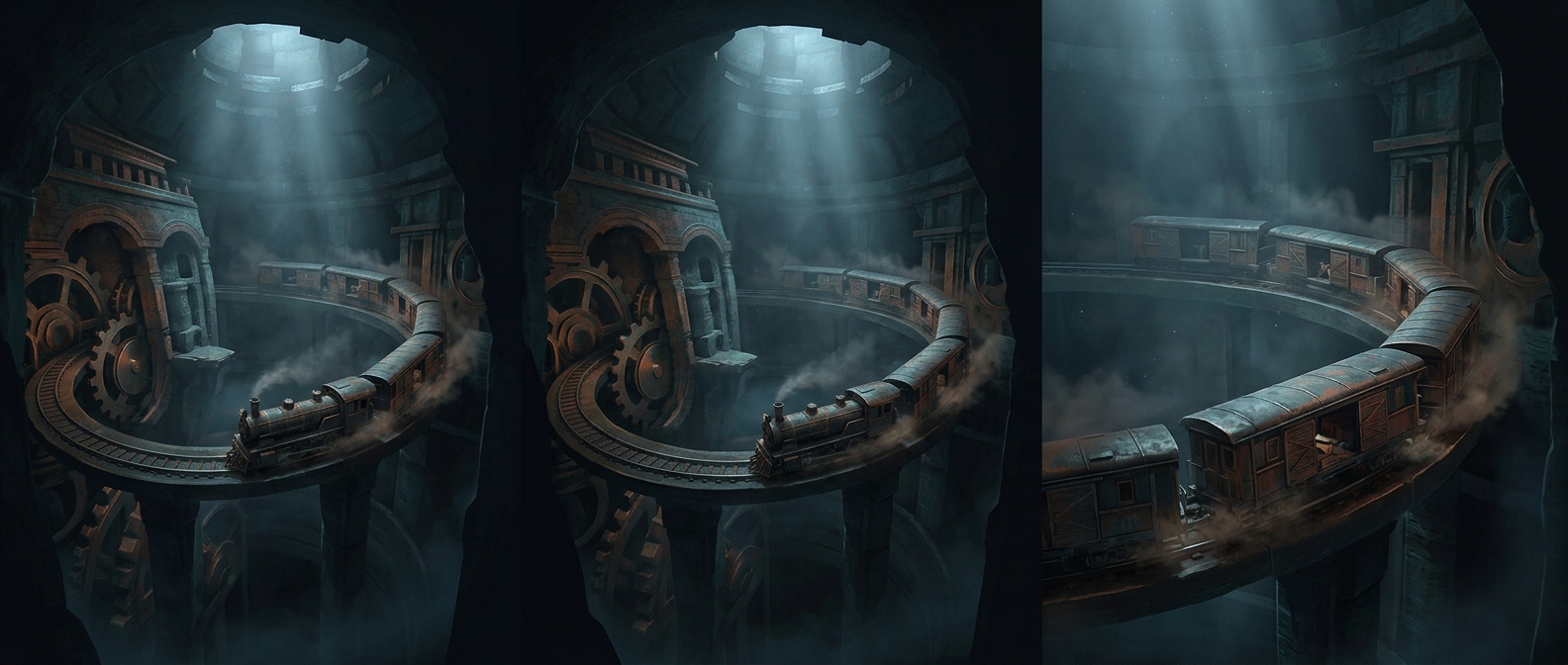
A train scene feels as though it is carrying the player steadily forward, but the game does not need a track that runs endlessly into the distance. The route can bend around and reconnect outside the camera’s view. Snowy slopes and other terrain block the sightline, concealing the turn and making the returning stretch of track look like a new part of the journey.
The camera completes the illusion
The trick depends on controlling what the player can see. In a fast-moving action sequence, attention is usually fixed on the train, nearby obstacles, and the next immediate threat—not on checking whether a distant mountain has appeared before. As the train circles back, the scenery visible through the windows can still suggest forward travel because the crucial connection stays hidden.
That makes a compact route feel much larger than it is. Instead of building and rendering a vast, continuous landscape, the game can reuse a bounded stretch of terrain while preserving the impression of a long ride. The loop also gives designers a predictable space for staging the sequence: the train can keep moving through a carefully arranged series of encounters without needing an open-ended world beyond them.
A set piece built around limited vision
The concealment is not merely a shortcut in the map. It turns the player’s restricted view into part of the design. The train feels relentless because it appears to keep pressing onward, while the hidden circular route lets the game control where the action goes next. The journey seems vast; the playable geography can fit inside a carefully concealed loop.