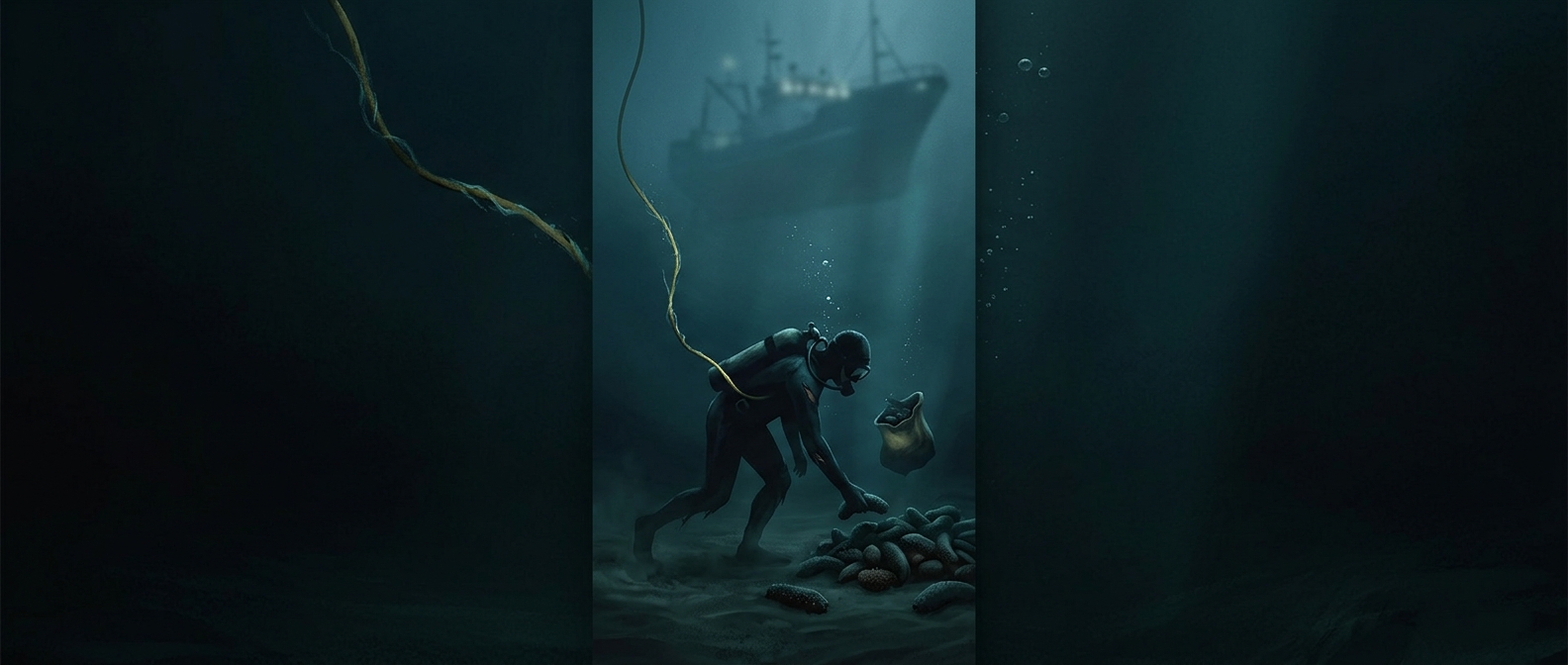
Why a Sea Cucumber Can Be Worth a Dangerous Dive
Sea cucumbers are sold dried as a luxury food, especially in parts of East Asia. Drying shrinks them dramatically, making a relatively small catch easier to store and ship—and valuable enough to attract buyers far from the coastal communities where it is gathered. For divers, the trade can turn a common-looking animal on the seabed into cash.
When the Catch Moves Deeper
Nearshore beds can be depleted by repeated harvesting. As the easy-to-reach animals become scarce, divers may travel farther offshore or descend to greater depths, where sea cucumbers remain. The economic pressure is direct: a deeper dive can offer access to a more valuable catch, but it also increases the time spent underwater and the danger of returning to the surface.
Some divers use a compressor on a boat to pump air through a hose. This setup can supply air without requiring a diver to carry a conventional tank, but it is not the same as a complete modern diving system. A kinked, severed, or blocked hose can interrupt the air supply; a diver can also become tangled or lose contact with the boat.
The Cost of Getting Back Up
At depth, pressure changes affect the gases a diver breathes. If a diver rises too quickly, dissolved nitrogen can form bubbles in the body, causing decompression sickness—sometimes called “the bends.” Severe cases can injure the spinal cord or brain, leave a person paralyzed, or prove fatal. Working deep and making repeated dives can compound the risk, especially when divers lack reliable equipment, training, or time to ascend safely.
The trade’s costs are often borne by the people doing the harvesting, while the dried product travels through a wider chain of buyers and sellers. A high market price does not make a dangerous dive safe; it can make the risk harder for a diver to refuse.