Why a Shoelace Bow Holds Under Tension
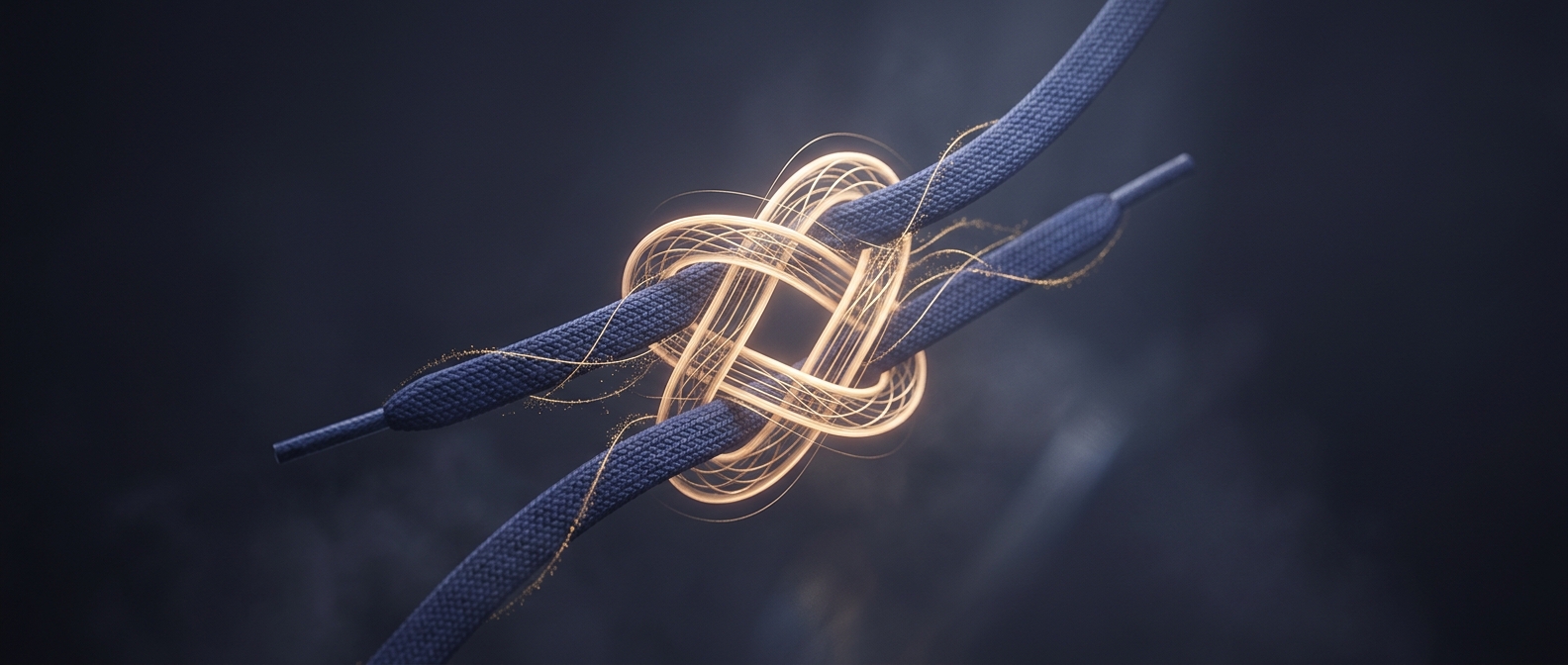
A tied shoelace is not locked like a buckle. It stays put because the lace bends sharply where its parts cross and press against one another. Those bends create friction: when the shoe pulls the lace taut, the contact points resist sliding, helping the knot keep its shape.
The bow’s center works like a reef knot, made from two crossings in opposite directions. That balanced arrangement lets tension from both sides tighten the center rather than simply twisting it into a different shape. The loops add another useful feature: they provide extra bends and contact points, while keeping the knot easy to release.
A Secure Knot With a Deliberate Weak Point
The bow is designed to hold during ordinary movement, not to become permanent. Pulling the lace ends tight increases pressure at the crossings and makes the knot harder to slip. To untie it, a sharp pull on one free end draws a loop back through the center. That changes the knot’s structure, removes the looped support, and lets the remaining lace slide free.
The balance depends on how the crossings are made. If the center twists into an uneven, lopsided knot, the lace can slip more readily; a neat, flat bow spreads tension more evenly. So the small everyday trick is not simply tying a loop: it is arranging friction to resist the forces of walking, while leaving a loop that can undo the whole arrangement in one pull.