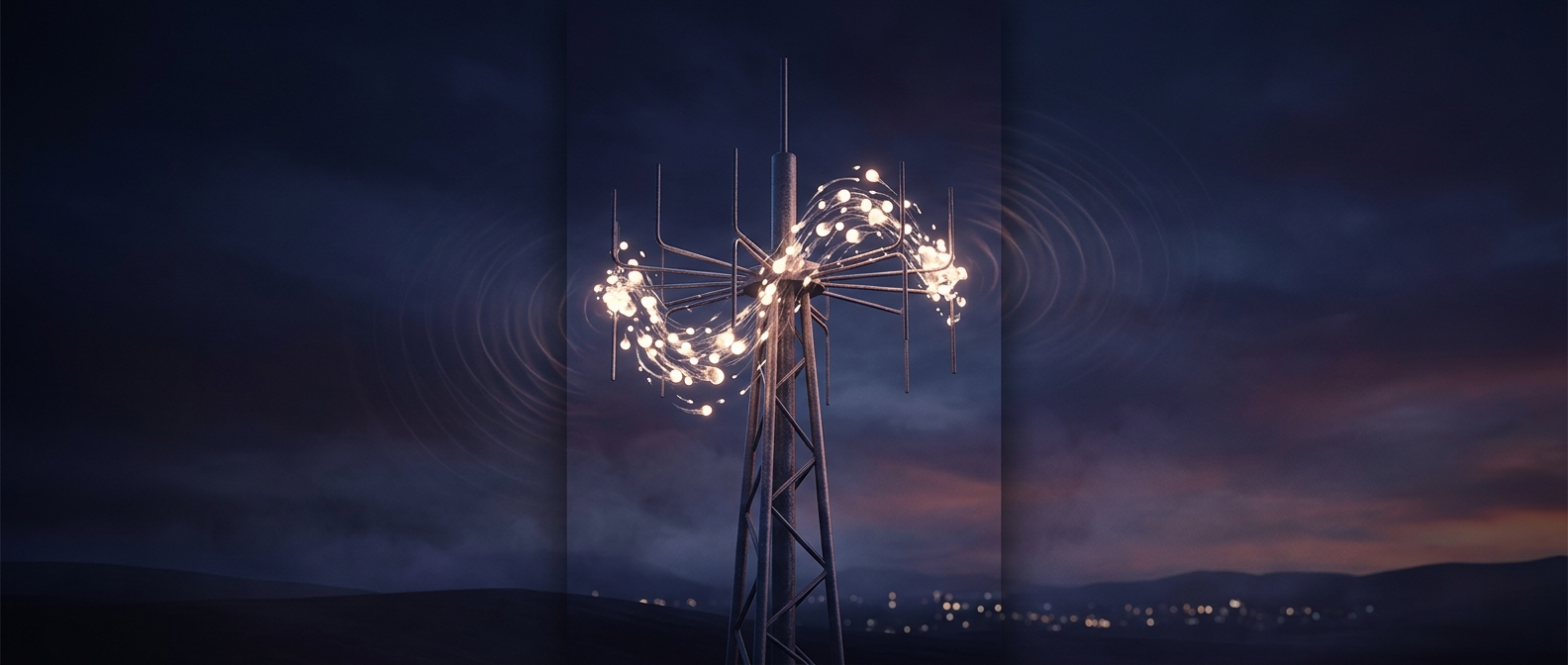
From Moving Electrons to a Radio Wave
A transmitter feeds an antenna an alternating electrical current: the current repeatedly reverses direction, so electrons in the metal shift back and forth. Their coordinated motion creates changing electric and magnetic fields around the antenna. Those linked fields can travel outward together as an electromagnetic wave—the same broad kind of wave as visible light, but at a much lower frequency.
The antenna does not launch electrons across the distance to a radio or television. Instead, it converts energy carried through wires into a wave that can cross open space. At a receiving antenna, the passing wave nudges electrons into motion, producing a tiny electrical signal that a receiver can amplify and decode.
Why Antenna Size Matters
The antenna’s dimensions are chosen in relation to the signal’s wavelength—the distance a wave travels during one cycle. An antenna near a useful fraction of that wavelength can exchange energy with the wave efficiently. That is why antennas designed for different broadcast frequencies can look very different: lower-frequency waves have longer wavelengths and generally call for larger antenna structures.
The metal elements also shape where the signal goes. A simple antenna may radiate in many directions, while an arrangement of elements can concentrate more energy toward a chosen area. Buildings, terrain, and nearby objects can reflect or absorb some of the wave, changing reception from place to place.
Broadcasting Without a Wire
A broadcast signal spreads because the antenna’s changing fields detach from the immediate electrical circuit and propagate outward at the speed of light. The receiver then turns a small slice of that passing energy back into an electrical signal. The antenna is a converter at both ends of the journey: electrical motion becomes a traveling wave, and the wave becomes electrical motion again.