Turning a Tiny Bend Into a Surface Map
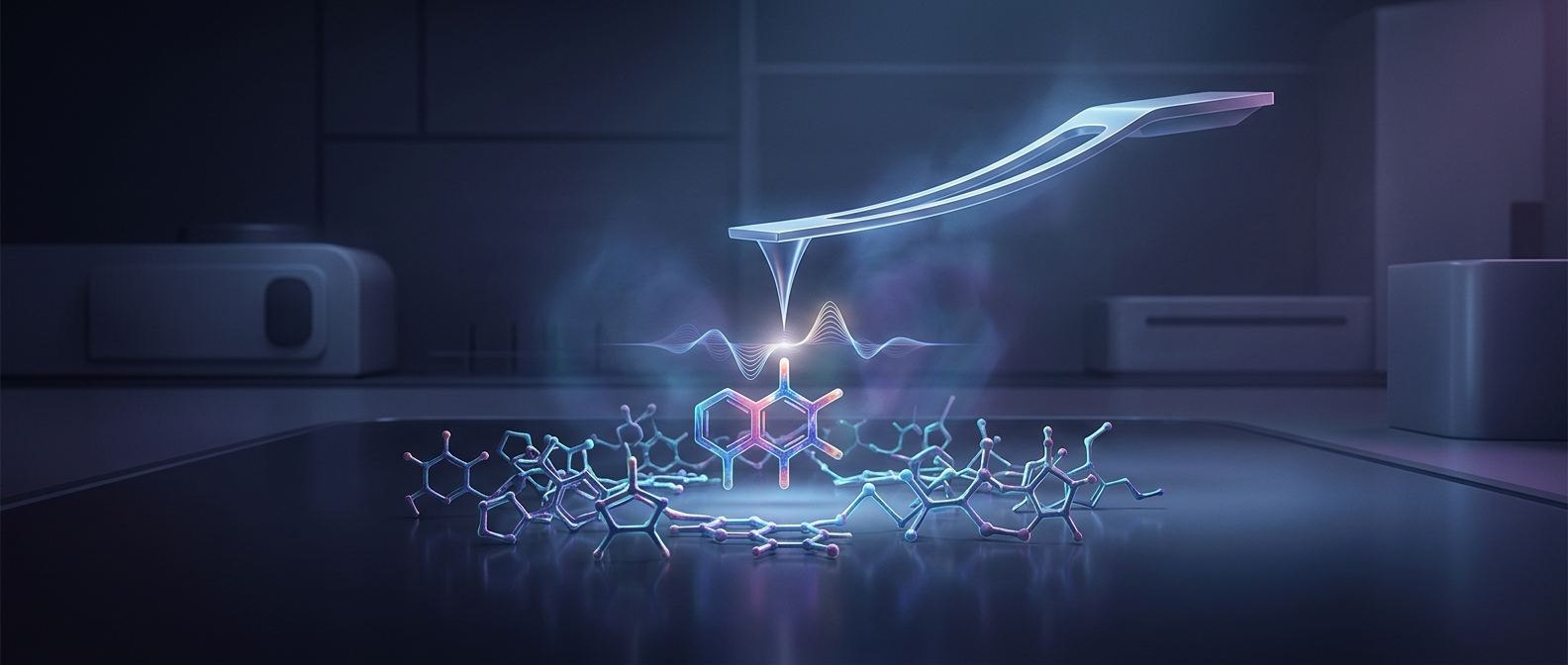
The probe is mounted on a flexible beam called a cantilever. As its sharp tip moves across a molecule, forces between the tip and the molecule bend the beam by an almost imperceptible amount. A laser reflects off the cantilever onto a detector; the shifting spot reveals how far the beam has moved.
The instrument scans in a tight back-and-forth pattern, recording the tip’s position and the beam’s response at each point. A computer uses those measurements to build a map of the molecule’s surface. In many scans, a feedback system adjusts the tip’s height to keep its interaction with the surface steady. The adjustments themselves trace the contours.
What the Map Shows—and What It Takes
This is not a photograph made with visible light. It is a picture reconstructed from the probe’s physical interaction with the surface. Its detail depends on the tip, the scanning method, and how the molecule is held in place. A molecule can shift or flex, and the measured outline can reflect the probe’s interaction as well as the molecule’s shape.
That sensitivity is also the technique’s strength: it can reveal surface features too small for ordinary optical microscopes to resolve. Researchers can examine how molecules are arranged or how their shapes change under different conditions—by reading the minute motions of a beam as the tip crosses terrain only molecules wide.