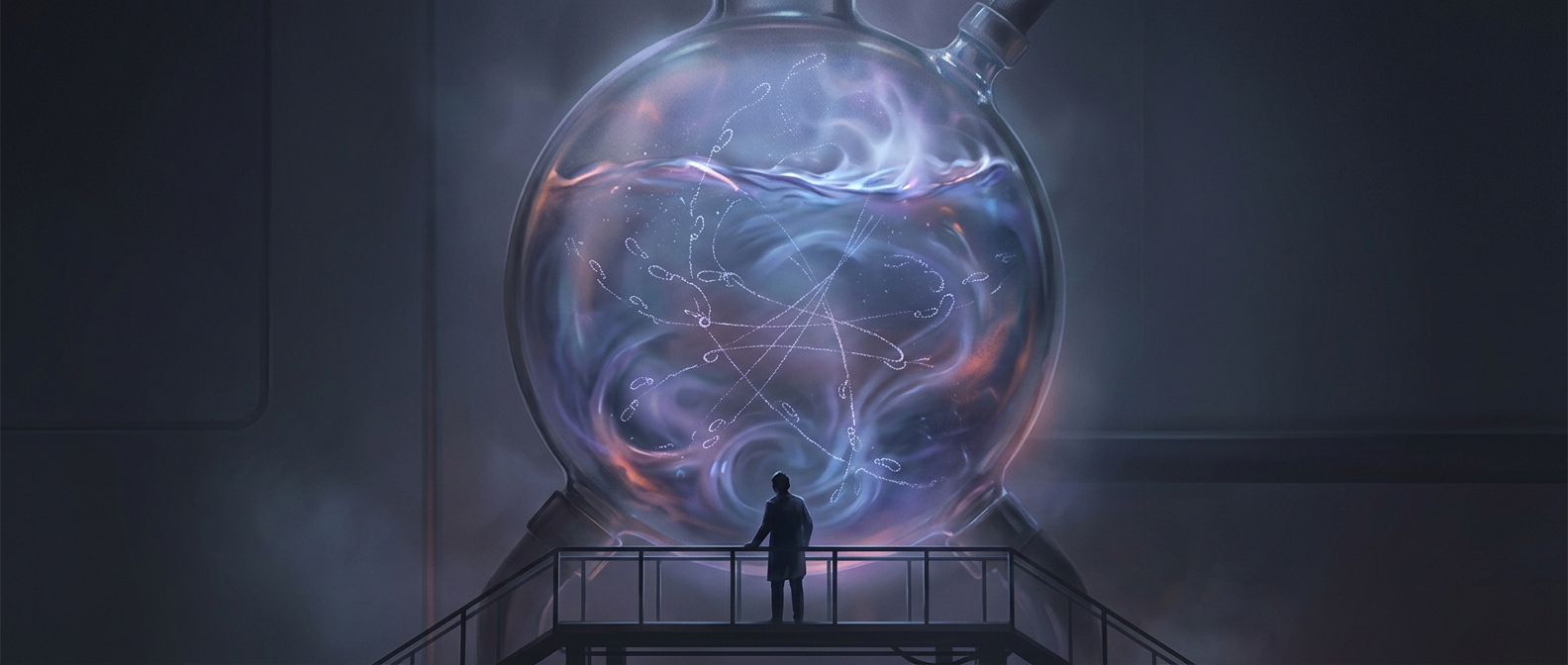
How a particle turns into a visible track
A fast, charged particle can pass through liquid hydrogen without being seen directly. As it moves, it knocks electrons off hydrogen molecules, leaving a narrow trail of ionized molecules—tiny patches where the liquid has been disturbed.
The hydrogen is superheated: it is warmer than its normal boiling point but kept liquid under pressure. In this delicate state, the liquid can remain clear until a disturbance gives bubbles a place to start. Along the particle’s ionized path, microscopic bubbles form and grow, tracing where it went.
Reading the bubbles
Cameras photograph the track before the bubbles become too large or numerous to distinguish. The image turns an invisible passage into a line scientists can measure. A magnetic field can bend the paths of charged particles; the direction and amount of bending help reveal their charge and momentum. Comparing tracks can also show where a particle changed direction or produced other particles.
The chamber has to be reset for another clear view: pressure is raised to collapse the bubbles, then lowered to return the liquid to its superheated state. The result is a detector that makes a fleeting event visible by letting the liquid itself mark the particle’s route.