How a simulated body stays connected
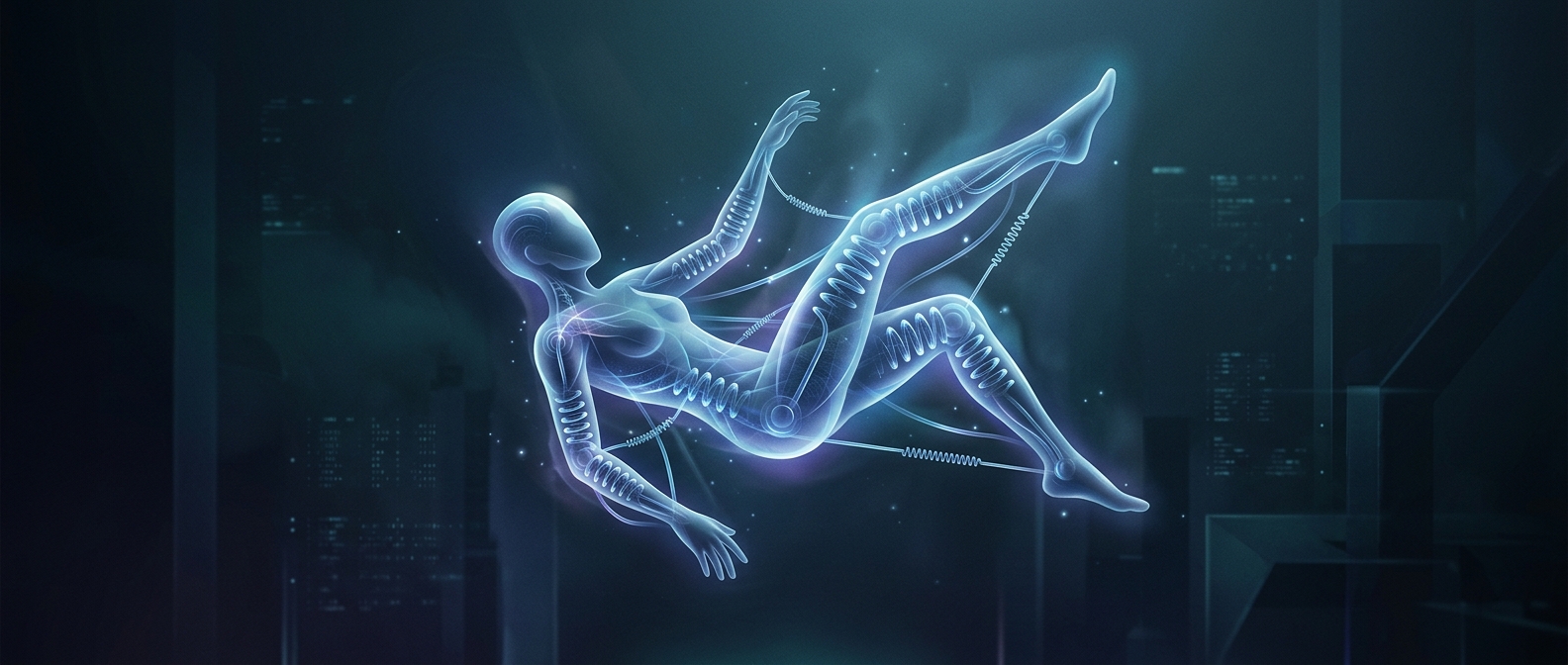
A game’s physics engine does not usually treat a falling character as one bendable object. It calculates motion for separate pieces—such as the torso, upper arm, and forearm—and connects them at joints. Each piece has a position and rotation; the joints tell the engine which movements are allowed between neighboring pieces.
A joint can act like a virtual spring: when two pieces drift from their intended relationship, it pulls them back toward it. But a spring alone would let an elbow swing endlessly or a shoulder rotate through the torso. Joint limits restrict that motion, much like a real hinge has a useful range rather than spinning freely in every direction.
The balance between floppy and rigid
When the character hits the ground, the engine applies forces to the separate pieces and repeatedly adjusts their movement to satisfy the joints. The result can look loose and reactive, but the limbs remain attached and bend within chosen ranges. The exact limits and spring strengths are design choices: tight settings make a body feel stiff, while loose ones make it more floppy.
Those calculations are approximate. The engine has to resolve many contacts and connections in a limited number of steps, so settings that are too soft can make joints stretch or wobble; settings that are too rigid can look abrupt or become difficult to simulate reliably. Designers tune the constraints to get a convincing tumble without requiring every body part to behave like a perfectly realistic anatomical structure.
That is why a game character can collapse in a surprising pose yet still read as a body rather than a pile of independent objects: the motion is free enough to look chaotic, but the joints keep chaos within bounds.