Why the Horizon Makes the Moon Seem Huge
The Moon does not cast a bigger image on the eye when it rises or sets. Its angular size—the angle it occupies in your field of view—stays nearly constant over the course of a night. Yet the brain does not read that image in isolation: it uses surrounding scenery to estimate how far away things are and how large they must be.
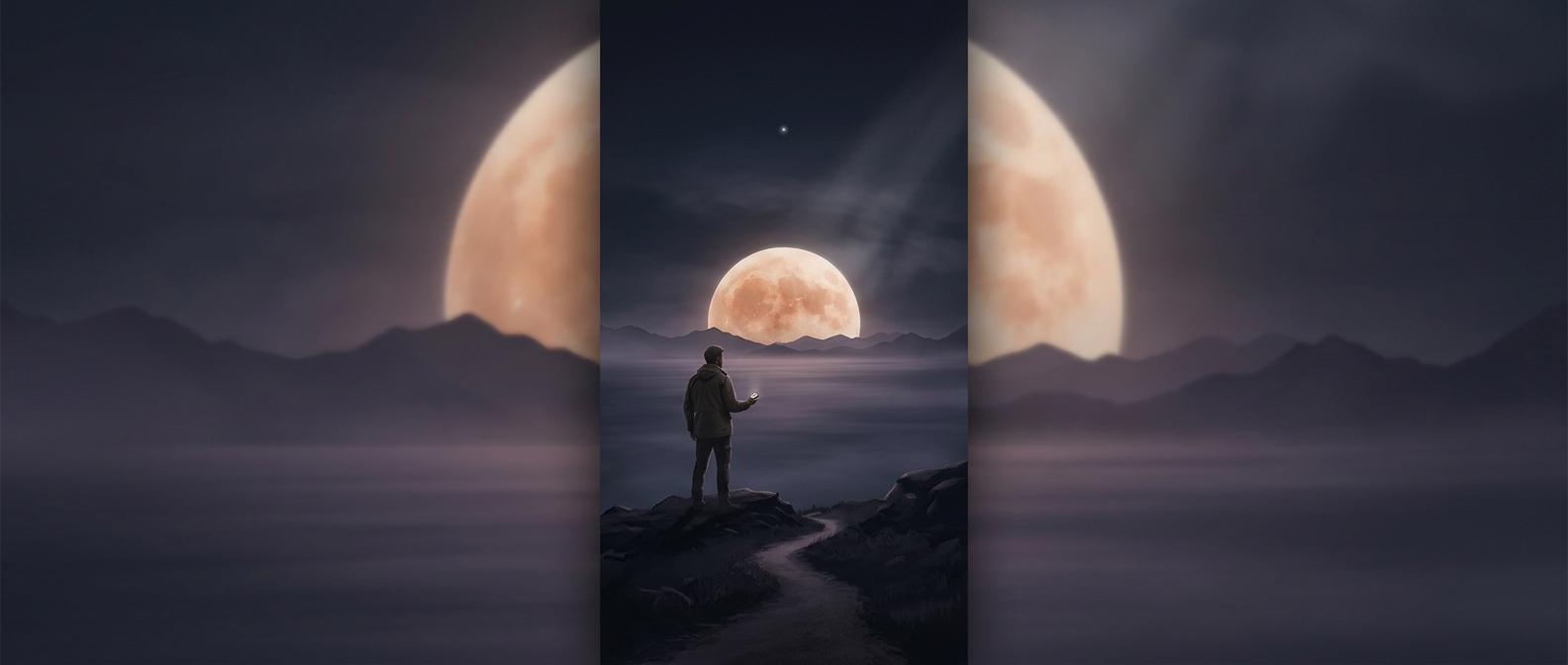
Near the horizon, the Moon appears alongside rooftops, trees, and other objects whose sizes and distances we know from everyday experience. Those comparisons give the scene a strong sense of scale, and the Moon can seem enormous by contrast. High overhead, it hangs in a broad, relatively empty patch of sky, with few familiar objects to anchor its apparent size.
The Brain’s Size-and-Distance Guess
Vision normally uses distance to help judge size. A nearby object and a faraway object can make the same-sized image on the retina, but we do not usually perceive them as equal in real size. The brain combines the image with clues about distance and context to make a best guess. In the Moon illusion, that process can make the horizon Moon seem larger even though its retinal image has not grown.
Researchers have proposed several contributing explanations, including how the sky appears shaped and how the horizon provides distance cues. There is no single account that explains every person’s experience. The useful point is that the effect arises in perception, not because the horizon magnifies the Moon.
A simple check makes the mismatch clear: compare the Moon’s apparent width with a fingertip held at arm’s length, first near the horizon and later overhead. The Moon may feel dramatically different in size, while the comparison changes little.