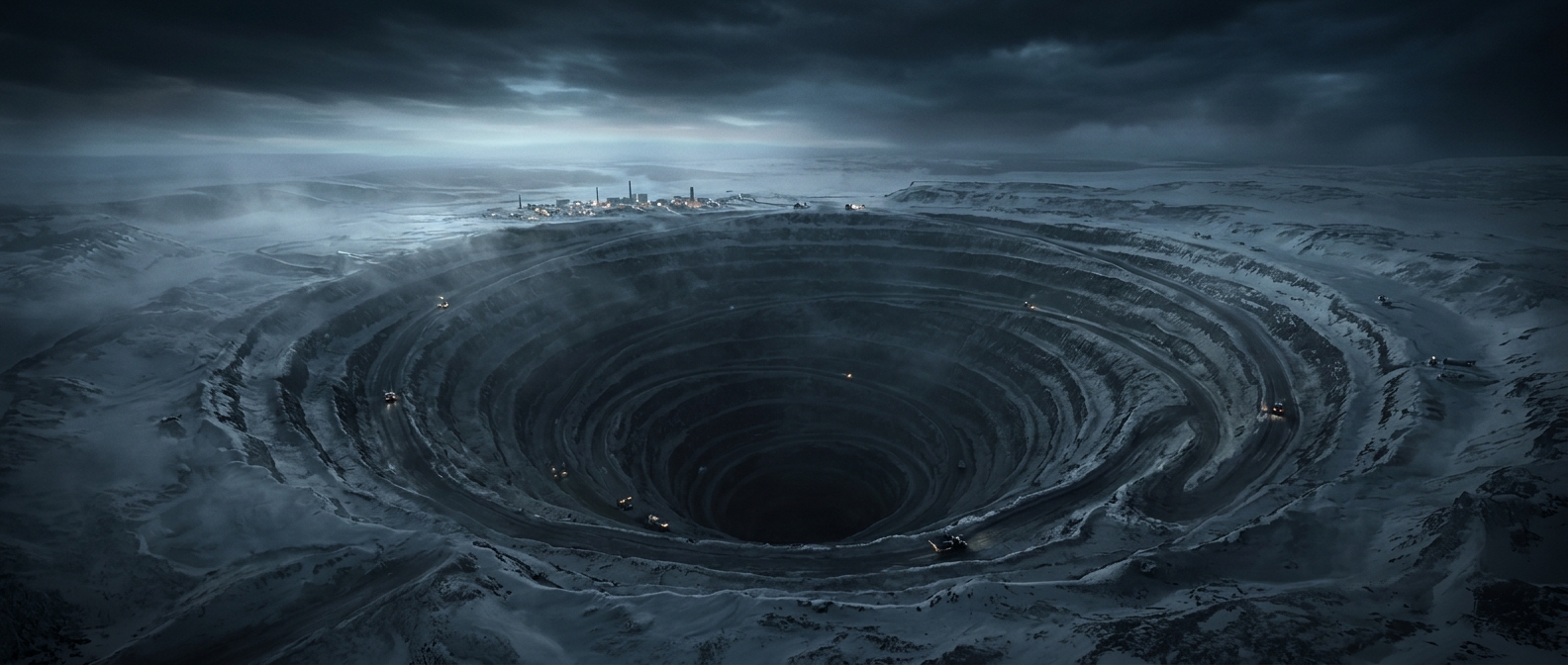
Why the Mir mine can unsettle the air around it
The Mir mine is a vast open-pit diamond mine near the town of Mirny in Russia’s Sakha Republic. Its steep, bowl-like walls make it a striking landscape feature—and a potential source of complicated airflow for aircraft flying close to the rim.
Wind hitting a deep pit does not simply vanish into it. Instead, the rim and walls disrupt the surrounding air, creating turbulence and shifting wind direction. In some conditions, air can move downward along a slope or into the excavation. For a low-flying helicopter, sudden changes in wind can matter: the aircraft depends on carefully managed airflow through its rotor blades to stay aloft and maneuver.
Turbulence is not a giant vacuum
The mine does not create suction in the way a drain pulls water. A downdraft is moving air, not a force that automatically drags an aircraft into the pit. How strong or hazardous the airflow might be depends on weather, wind direction, and the helicopter’s position and altitude.
Stories that helicopters have been swallowed by the mine are not established by the information available here. The more grounded reason the crater has such a fearsome reputation is that its scale and steep sides make the consequences of losing control near the edge easy to imagine. The memorable detail is less a pit that reaches up for aircraft than a landscape where ordinary wind can become harder to read.