Why the hidden support disappears from view
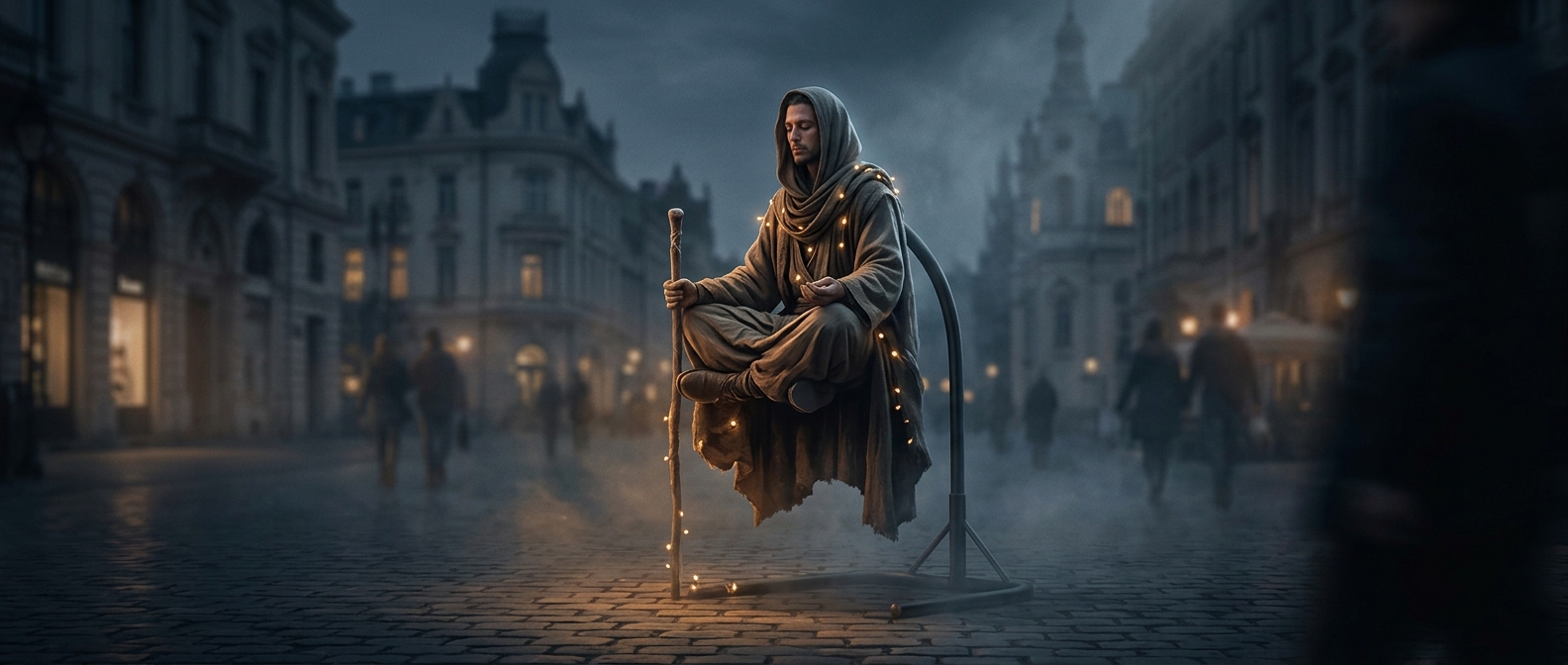
The illusion depends on more than hiding a chair. A concealed support must carry the performer’s weight, while the costume and pose make the support hard to distinguish from the performer or surrounding shapes. To a passerby, the body appears to have no visible connection to the ground. The actual structure is out of sight, but its effect is still there: it holds the performer steady.
That missing connection is the crucial visual clue. In ordinary scenes, people expect a body to be supported by a chair, a floor, or something else they can see. When the expected support is obscured, the brain does not stop to reconstruct every hidden part of the scene. It makes a quick, plausible interpretation from the visible evidence—and here, that can be “floating.”
Attention completes the trick
A viewer usually sees the pose from a limited angle and for a short time. The performer’s shape and stillness draw attention; the costume hides details that might reveal how the weight is being carried. Because the support is both concealed and visually masked, viewers may not think to search for it at all.
The effect is therefore not a failure of vision so much as a fast inference made with incomplete information. Change the viewpoint, notice an unexpected fold in the costume, or inspect the setup closely, and the scene can be interpreted differently. The performer never has to defy gravity: the illusion works by hiding the evidence of what is holding them up.