Why bismuth seemed stable
For a long time, bismuth was treated as the heaviest element with no radioactive isotopes. Its common form, bismuth-209, does not visibly change in a sample: individual atoms wait far longer than any human timescale before one decays.
That apparent permanence comes from the structure of its nucleus. A nucleus is a tightly bound cluster of protons and neutrons, and changing it requires getting past an energy barrier. In bismuth-209, that barrier makes decay extraordinarily unlikely—not impossible.
A rare escape from the nucleus
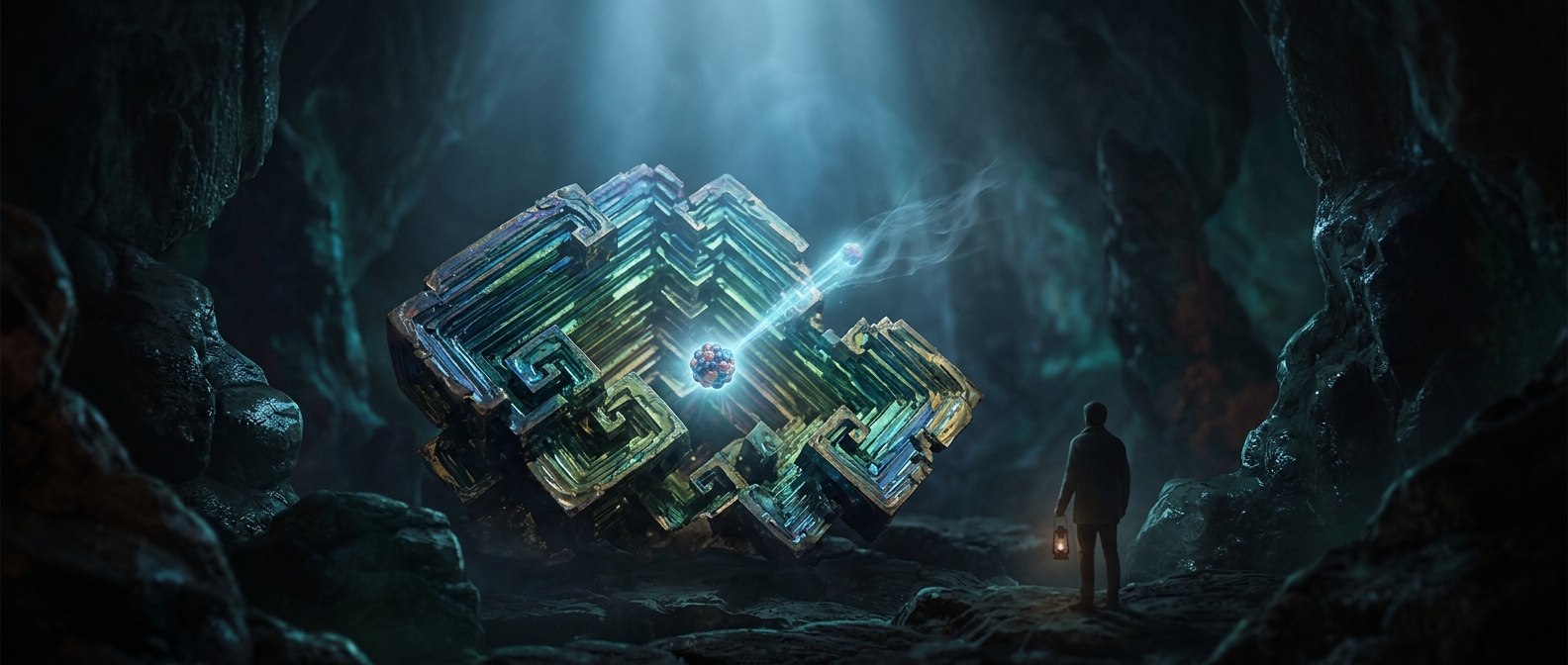
When a bismuth-209 nucleus does decay, it emits an alpha particle, a compact group of two protons and two neutrons. Losing those particles changes the nucleus into thallium-205, a different element because it now has fewer protons.
The process is called alpha decay. It can happen even when the particle does not have enough energy to climb over the nuclear barrier in the ordinary sense: quantum mechanics allows a small chance that it will pass through. For bismuth-209, that chance is so small that a given atom is overwhelmingly likely to remain unchanged for an immense span of time.
Real radioactivity, almost no everyday effect
A long-lived radioactive material can still produce decays; the key is that each atom has only a tiny chance of decaying in any given interval. So a bismuth object can look and behave as stable as an ordinary metal while its atoms quietly transform one by one.
The distinction is a useful reminder: “stable” in everyday life often means “nothing changes while we are watching.” In nuclear physics, it means something stricter—no decay at all. Bismuth-209 misses that mark, but by so little that its instability is measured on timescales far beyond a human life.