Why Bismuth Builds Recessed Steps
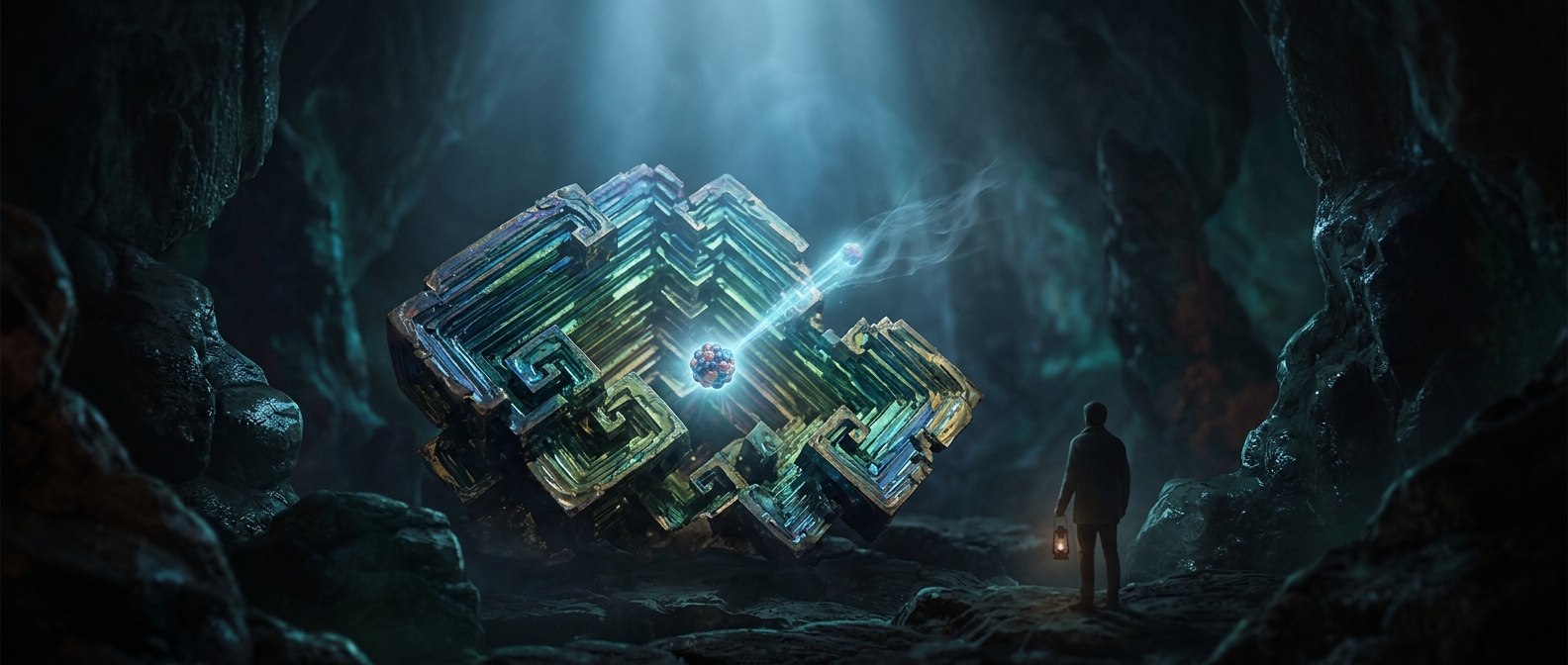
Bismuth’s staircase shape comes from how its crystal grows, not from layers being carved into the metal. As atoms join a growing crystal, they can attach more readily at its edges and corners than across the broad, flat middle of a face. The edges advance while the center lags behind, leaving a recessed outline. Repeating that uneven growth produces the square, nested steps known as a hopper crystal.
A Surface Film Turns the Steps Colorful
After the crystal is exposed to air, oxygen reacts with its surface to form an extremely thin oxide coating. The film can vary in thickness across the crystal, including from one part of a step to another.
Light reflects from both the top of the oxide and the boundary where the oxide meets the metal. Those reflected waves overlap: for some wavelengths they reinforce one another, while for others they partly cancel. Because the outcome depends on the film’s thickness, neighboring areas can reflect different colors even though the underlying bismuth is the same metal throughout.
The steps therefore do double duty. Their uneven surfaces help create the crystal’s dramatic geometry, while their varied angles and coating thicknesses make the color shift across the structure. The rainbow is a record of a thin surface film, not a property hidden inside the metal.