Why a nearby gadget can drown out the sky
A radio telescope does not take pictures of radio waves. Its dish gathers them and concentrates them onto a receiver, which measures tiny changes in signal strength. The signals can come from distant objects such as pulsars or clouds of gas, but they arrive at Earth extraordinarily faint.
Electronics can transmit radio energy unintentionally, too. A device does not need to be making a call: its circuitry may leak signals, and wireless equipment deliberately sends them. To the telescope’s sensitive receiver, nearby interference can be like trying to hear a whisper beside a loudspeaker. It can obscure the astronomical signal before researchers have a chance to analyze it.
Quiet is managed, not absolute
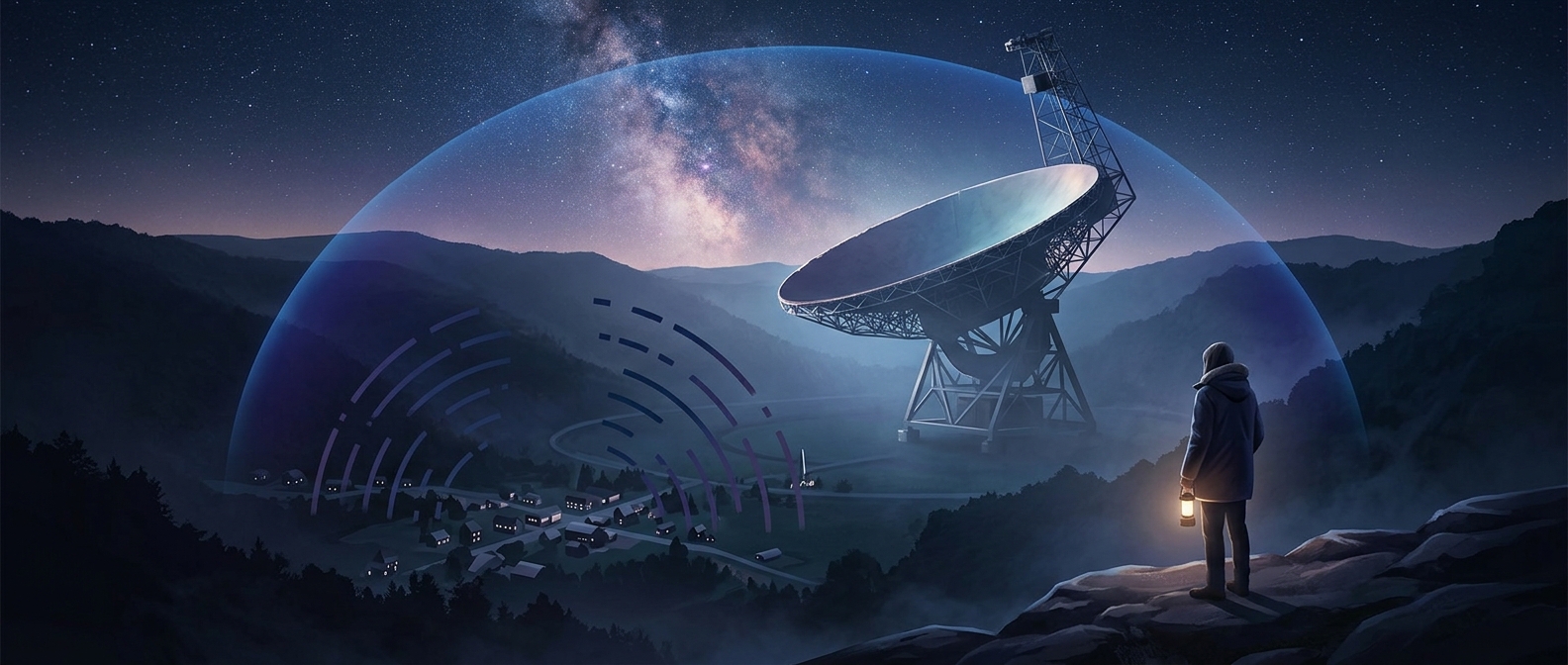
Green Bank sits within the National Radio Quiet Zone, a large area where radio transmissions are regulated to protect sensitive research. The rules are not a blanket ban on every transmitter. Restrictions depend on factors such as location and signal strength, with especially careful control close to the observatory.
That arrangement makes the telescope’s surroundings part of the instrument. Researchers need not only a large dish and sensitive receivers, but also a site where everyday radio traffic is limited enough for faint signals to stand out. At Green Bank, protecting the view of the universe means managing what people and machines transmit on the ground.