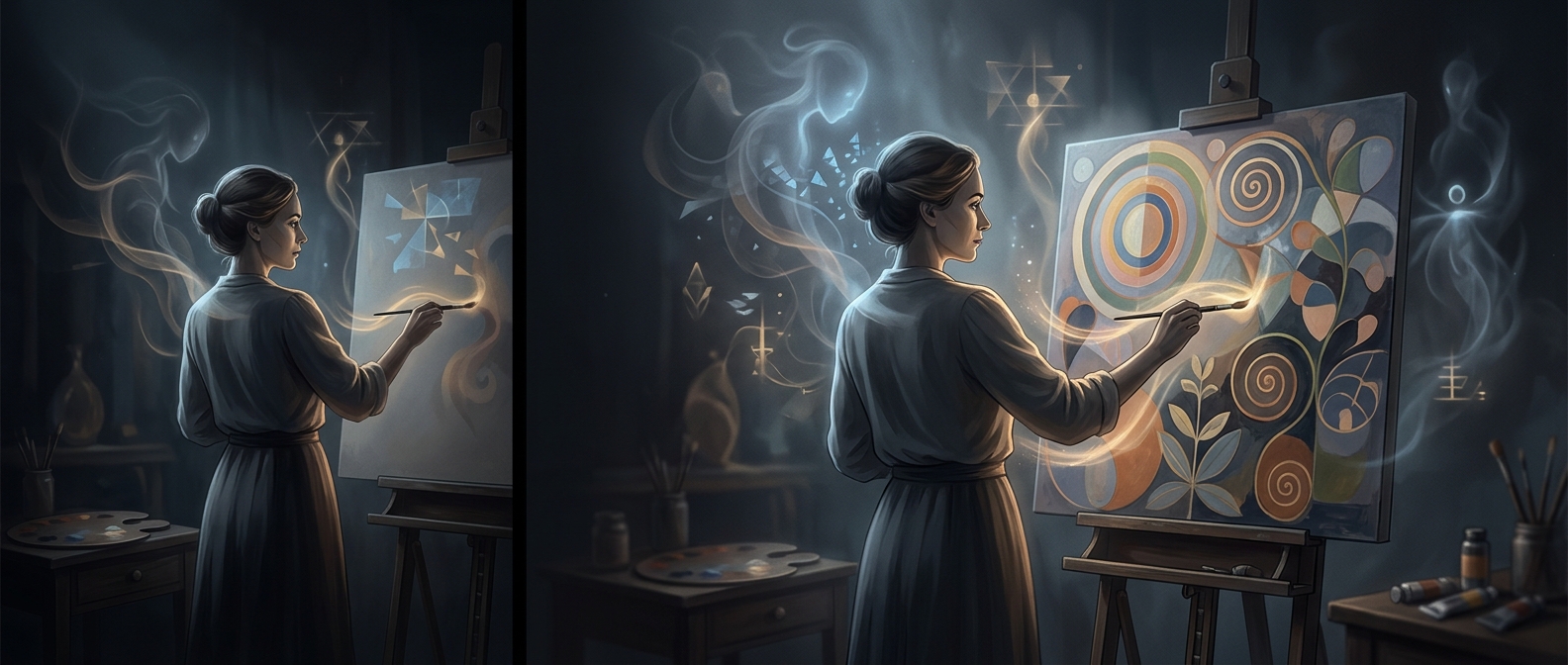
A commission for an unseen world
In 1906, Swedish painter Hilma af Klint began making large abstract works at a time when most European art still aimed to depict recognizable people, places, or objects. She said spiritual guides known as “The High Masters” had directed her to create them. For af Klint, the paintings were not puzzles or experiments in pure design: they were images of realities she believed ordinary sight could not reveal.
That belief shaped the forms. Spirals, circles, paired colors, and repeated geometric patterns gave her a visual vocabulary for spiritual ideas. Abstraction let her represent what she understood as forces and relationships, rather than illustrate a scene from the visible world. The guides’ instructions provided a purpose for the work; they did not make the paintings automatic. Af Klint still had to translate that purpose into compositions, color, and scale.
Why the paintings stayed hidden
Af Klint treated the pictures as parts of a larger undertaking, later known as The Paintings for the Temple. She stipulated that the works should not be shown until 20 years after her death. The condition reflects the gap she saw between making the paintings and having an audience prepared to understand them; it also meant that her most radical work could not shape public debates about modern art while she was alive.
She died in 1944, but the collection did not reach a broad audience as soon as the waiting period ended. As a result, viewers encountered much of this abstract work decades after its creation. Her story is often told as a claim to have “invented” abstraction, but the more precise point is striking enough: af Klint made ambitious abstract paintings in 1906, guided by a spiritual commission, and kept them out of public view for most of her life.