How a magnetic tangle becomes an eruption
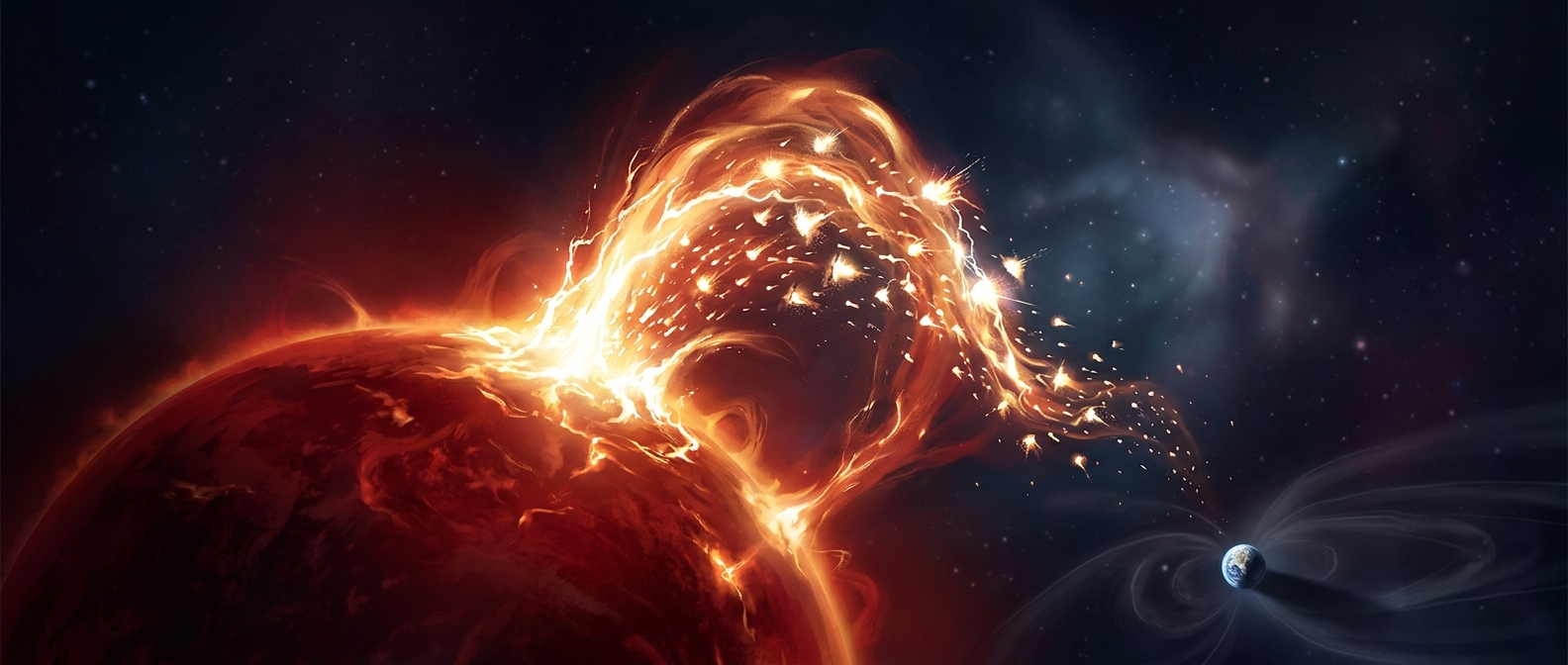
The Sun’s visible surface is not solid: it is a churning layer of electrically charged gas, or plasma. Because plasma carries magnetic fields with it, moving gas can bend and twist those fields, storing energy like a stretched spring. When the magnetic arrangement becomes unstable, field lines can reconnect—breaking and joining in a new pattern. That rapid change releases stored energy and can propel a vast mass of plasma away from the Sun.
The eruption is not a nuclear detonation. The energy comparison describes the scale of the energy involved, not the way it is released: there is no bomb-like shock wave racing through space. Instead, the ejected cloud travels outward carrying magnetic fields and charged particles.
What happens if the cloud reaches Earth
Earth’s magnetic field forms a protective region around the planet, but it can be disturbed when an incoming cloud’s magnetic field interacts with it. Some charged particles are guided toward the atmosphere near the poles, where collisions with gases can produce auroras. A strong disturbance can also create changing magnetic conditions around Earth, which induce electrical currents in long conductors such as power lines.
That is why the same solar eruption can be a spectacle in the sky and an engineering concern on the ground. Its effects depend not just on how much energy it carries, but on how the cloud’s magnetic field is oriented when it arrives.