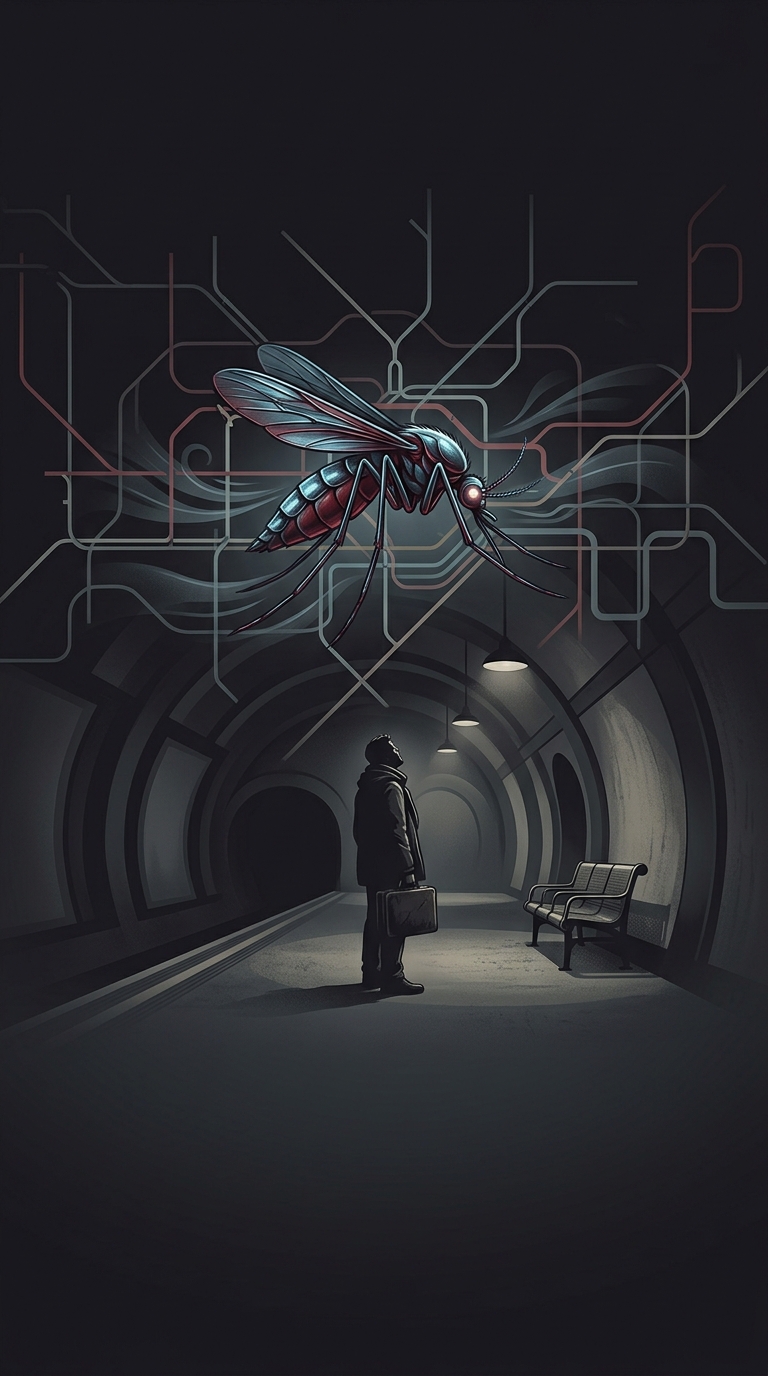
A mosquito adapted to life below street level
The London Underground’s famous subterranean mosquito is Culex pipiens molestus, often described as a form of the common house mosquito. In the tunnels, it encounters a very different world from the one its surface-dwelling relatives inhabit: little seasonal change, no winter to wait out, and hosts close at hand. Rats and other animals can provide blood meals, and people may be bitten too.
The key adaptation is not a special ability to navigate in darkness. It is a life cycle suited to enclosed spaces. A female of this form can produce her first batch of eggs without first taking a blood meal, a trait called autogeny. That gives her a way to reproduce even when suitable hosts are scarce. The mosquitoes can also mate in cramped places, unlike related forms that typically swarm in open air.
How an underground population can become different
When a population stays apart from its relatives, small inherited differences can accumulate. In a sheltered, human-built habitat, traits that help mosquitoes feed, mate, and reproduce there are more likely to persist. Over generations, that can produce a population adapted to its surroundings without requiring a sudden transformation or a planned change.
London’s underground mosquitoes drew attention during the Second World War, when people sheltering in Tube stations complained of bites. The tunnels made the contrast hard to miss: a mosquito could remain active below ground while the surface world moved through winter. The name molestus refers to a troublesome form, but it is not a species that evolved specifically to feast on commuters.
The same kind of underground-adapted mosquito has been reported in other cities, and its classification and origins are more complicated than the popular “London-only species” story suggests. Still, the Tube offers a memorable example of how transport infrastructure can create a habitat: a network built for trains can also sustain a population with a life cycle tailored to the dark, sheltered spaces around them.