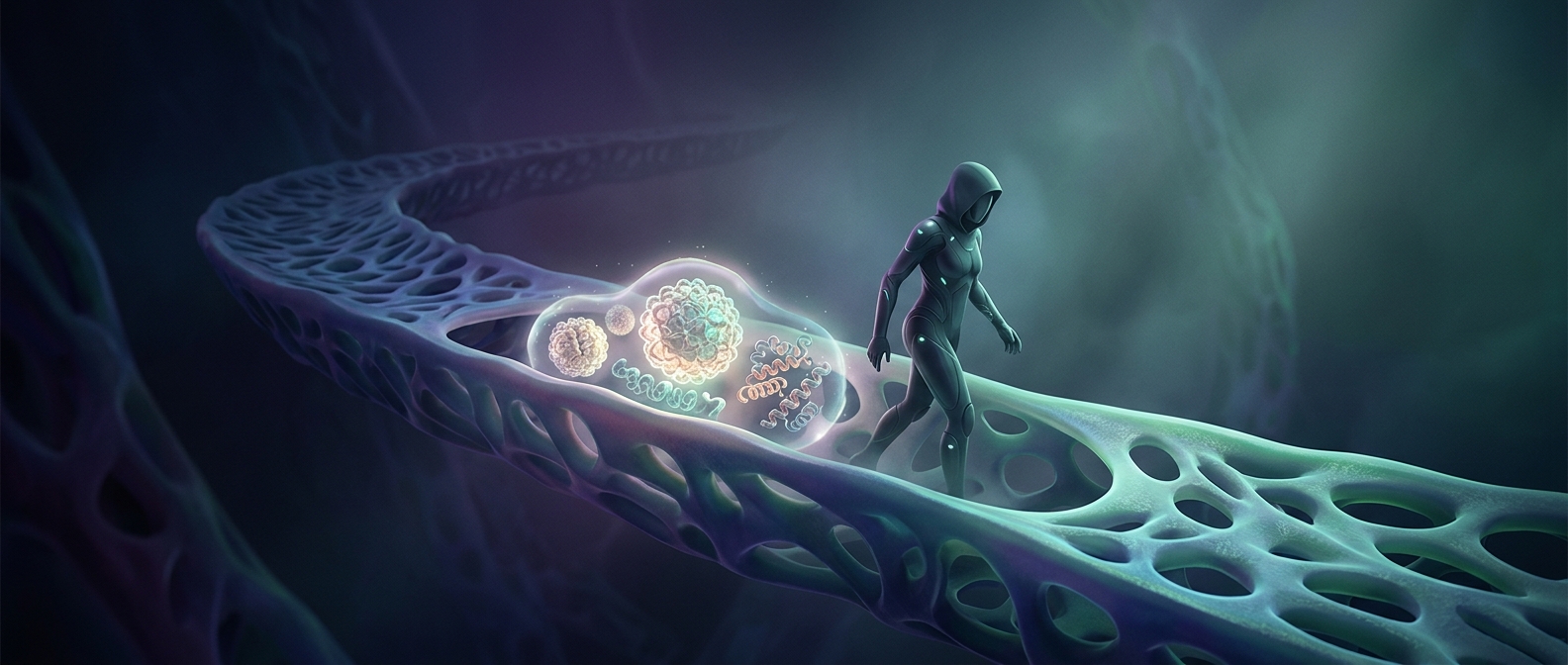
How a Cell Swallows a Molecular Package
A cell’s outer membrane is made largely of fats, which makes it a poor route for many large, water-friendly molecules. A lipid nanoparticle offers another way in: it bundles cargo inside a tiny structure made from fat-like materials that can interact with the membrane rather than trying to pass through it intact.
The cell can take up the package through endocytosis—a process in which the membrane bends inward, surrounds material outside the cell, and pinches off a small pocket. The nanoparticle and its cargo are now inside that pocket, called an endosome. This is closer to a cell engulfing a parcel than to a molecule slipping through a doorway.
Getting Past the Pocket
Entry is only part of the delivery problem. An endosome is a compartment inside the cell, separated from the rest of the cell by its own membrane. For cargo to do its job, it often has to escape that compartment and reach the appropriate place within the cell. Lipid nanoparticles are designed to help with this step as well: their components can interact with the endosomal membrane, making it possible for some cargo to get out.
The precise route and outcome depend on the nanoparticle and the cargo. Some packages are broken down or remain trapped, so uptake alone does not guarantee that a useful amount reaches its destination.
Why the Packaging Matters
The strategy turns the membrane from an obstacle into part of the route. Instead of forcing a large molecule through the cell’s greasy outer layer, the package encourages the cell to carry it inward in a membrane-bound pocket—and then helps release the cargo where it can act. That two-stage journey, cellular uptake followed by escape from the endosome, is the key to understanding how a nanoparticle can deliver what a bare molecule often cannot.