Two incomplete records, one pilot
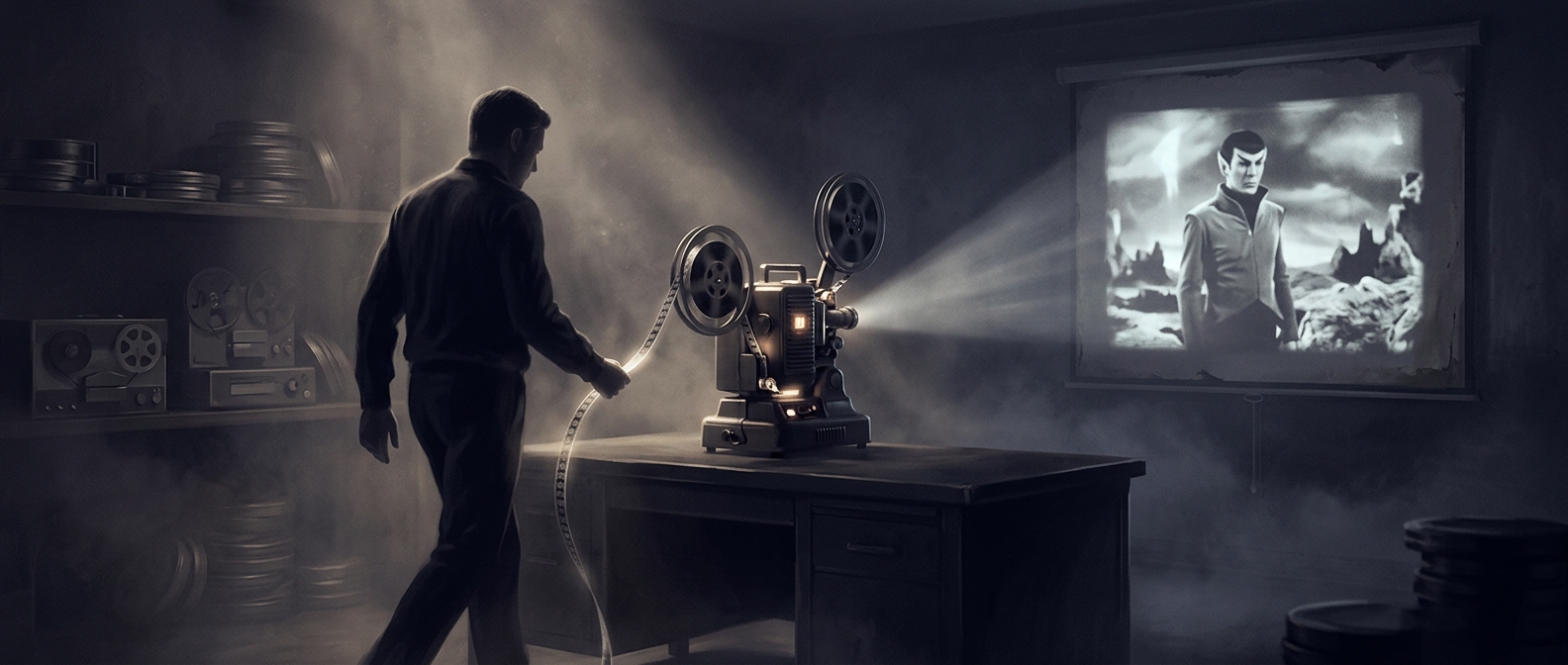
“The Cage” survived in two different forms. Gene Roddenberry, Star Trek’s creator, owned a black-and-white 16mm print of the original pilot. Separately, unused color footage from the production turned up in a Hollywood vault. Neither source alone provided the material needed for a complete color reconstruction.
The archivists’ task was to bring those fragments together: use the surviving print as a guide to the pilot’s sequence, then match color footage to the corresponding moments wherever it existed. That meant treating the sources not as interchangeable copies, but as pieces of a larger record.
Rebuilding the viewing experience
A black-and-white print can preserve what happens in a scene while losing its original color. Unused color footage can restore that visual information, but only for the shots it contains. Combining the two therefore depended on matching scenes and action, rather than simply applying color to the entire surviving print.
The result was a version assembled from materials with different histories and limitations. Its existence shows why film archives can hold more than one kind of evidence: a print may preserve continuity, while production footage preserves images missing from that print. In this case, the pilot’s recovery depended on finding both—and on recognizing how each could fill the other’s gaps.