Why alchemy becomes a monster story
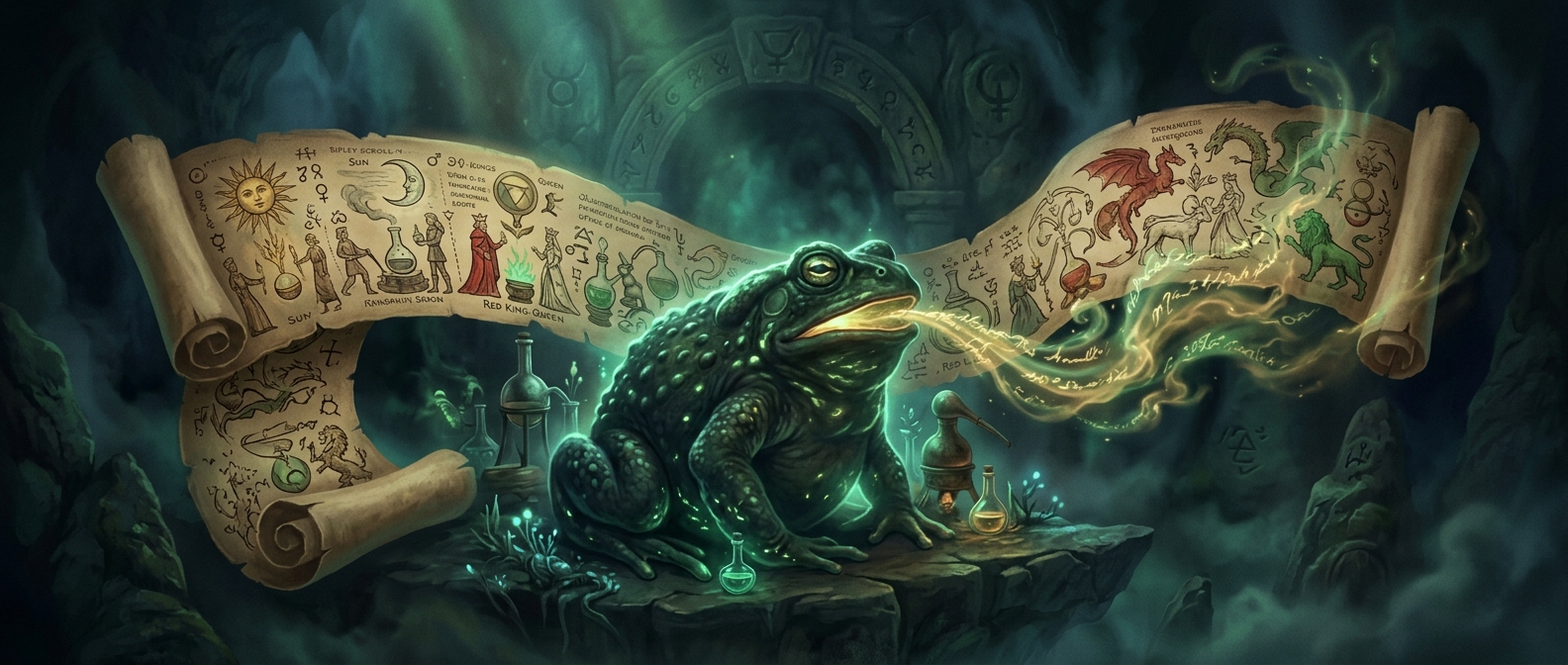
The Ripley Scroll does not read like a modern laboratory manual. Its giant toad and dragon belong to a tradition in which alchemical work was described through riddles, transformations, and symbolic creatures. The images turn a difficult process into a memorable sequence: something takes in material, changes violently, and emerges as something new.
That sequence can suggest the alchemist’s central concern—how one substance might be transformed into another—but it does not function as a one-to-one code with a universally agreed translation. Readers have connected alchemical creatures and colors to materials and stages of work, yet the same image could carry several meanings. The scroll invites interpretation rather than supplying a dependable recipe.
A picture that teaches—and withholds
Alchemical writing joined practical experimentation to theories about nature and matter. Its authors might describe heating, mixing, or changing substances while also presenting those operations as spiritual or cosmic transformations. A creature swallowing the earth’s juices can therefore be read as an image of material being absorbed and altered, not as a literal animal or a precise instruction.
The riddle had practical advantages. It made a complicated sequence easier to remember, while requiring readers to know the tradition before they could make sense of it. And because the symbols were ambiguous, they could preserve an author’s ideas without laying out a procedure in plain, reproducible steps.
The scroll’s strange narrative is thus part of its method: it makes transformation vivid while keeping its exact meaning elusive. Its toad does not hand over a formula; it makes the reader confront alchemy as a practice of interpreting change.