The straight man sets the comic baseline
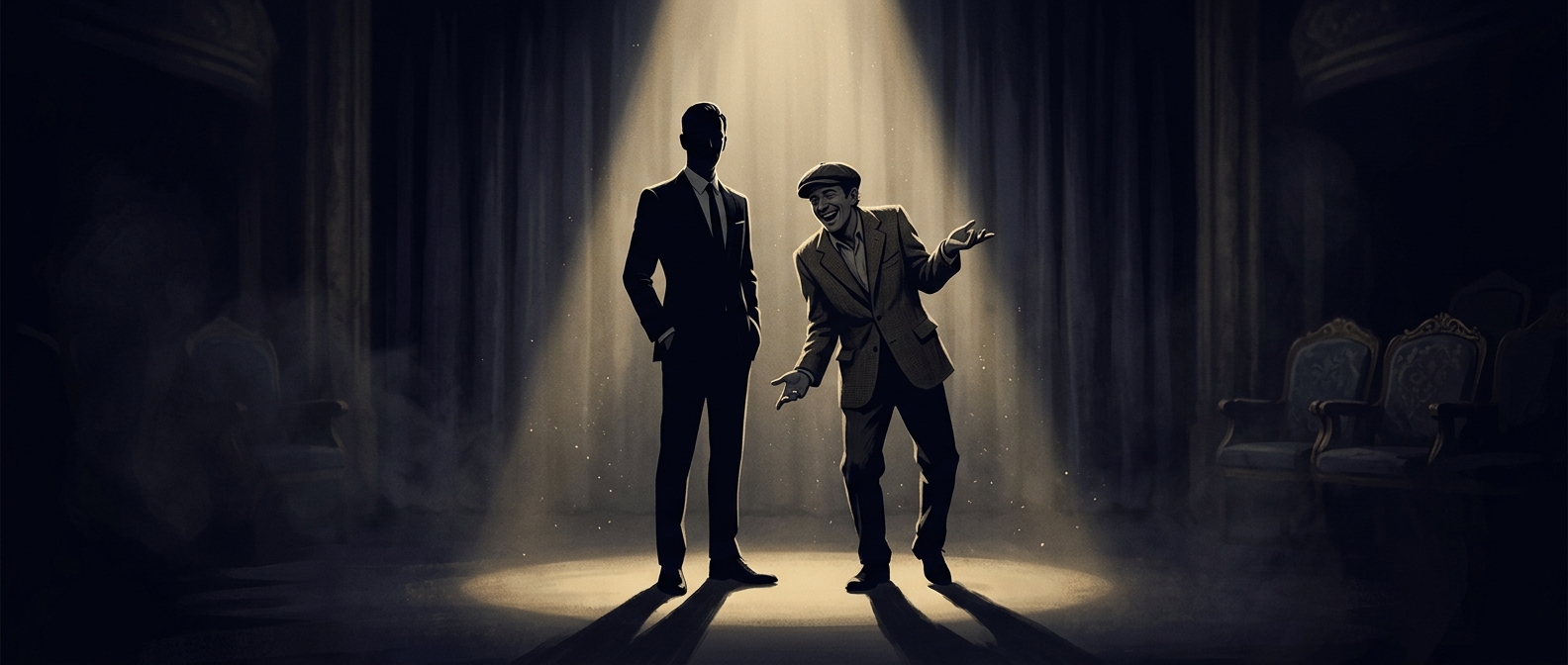
A comedy duo needs more than one person doing funny things. It needs a clear sense of what counts as ordinary, so an audience can feel how far the scene has veered from it. The straight man supplies that baseline: a character who treats the situation as if it should make sense, even when a partner’s choices do not.
That role is not simply “the serious one.” A straight man can be sharp, irritated, or visibly bewildered. What matters is that the response gives the audience a stable point of comparison. If both performers behave as wildly as possible, the scene may become noisy but harder to read; the audience loses the contrast that makes each absurd turn register.
Reaction turns chaos into a rhythm
The straight man’s pauses and replies help shape the timing. A strange claim lands, the partner leaves a beat for it to register, and the straight man answers with the practical objection everyone is already thinking. That response confirms the absurdity without explaining the joke. It also gives the first performer something to push against—an objection to ignore, a rule to break, or a fresh chance to escalate.
This creates a repeating engine: disruption, reaction, and a bigger disruption. The straight man’s composure can make a small oddity seem glaring; a crack in that composure can then become a comic event of its own. The audience is not just watching one performer misbehave. It is watching another try, and increasingly fail, to keep the scene within ordinary bounds.