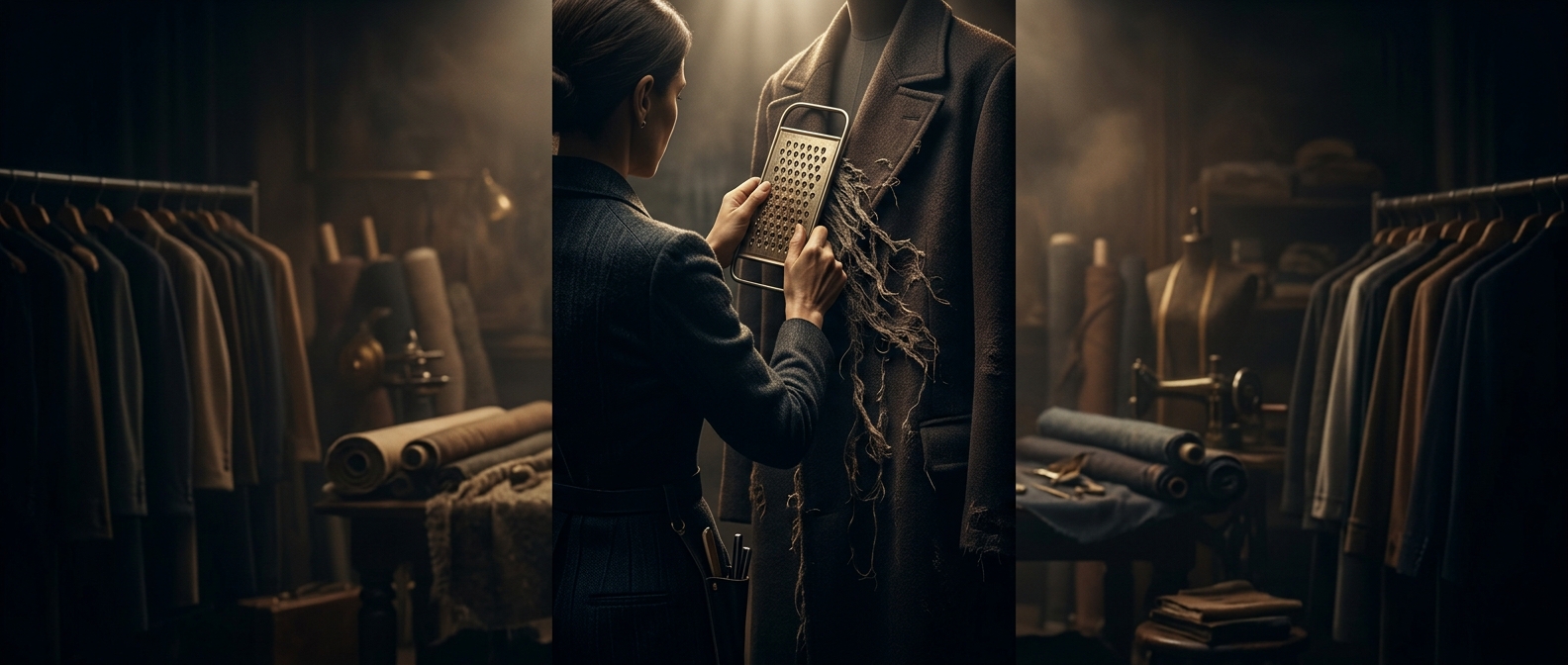
Wear Has to Tell a Story
A costume that looks old on camera is not simply a clean garment with damage added everywhere. Designers first decide what kind of life it has had. A jacket worn daily might lose its crisp edges and soften at the elbows; clothing caught on rough surfaces might show more concentrated scuffs. The placement of wear helps viewers read the garment—and its owner—before anyone explains a thing.
Distress the Surface, Not Just the Shape
Abrading fabric works by disturbing or removing some of its outer fibers. That breaks the smooth, uniform finish of new cloth, making it look softer, faded, or frayed. The tool matters less than the control: too little abrasion can vanish on camera, while too much can make a garment look torn rather than lived in. Different fabrics also respond differently, so the same treatment will not produce the same result on every jacket.
Make the Damage Repeatable
A costume has to survive more than one take. Actors move, scenes may be filmed out of story order, and a garment can be needed again after a break. If a scuff shifts or grows between shots, the change can distract even when viewers cannot identify why. Designers therefore treat wear as part of the garment’s continuity: its marks need to fit the character and remain consistent from scene to scene.
That is why convincing aging is less about making clothes look battered than about choosing a few believable signs of use—and putting them where a real life would leave them.