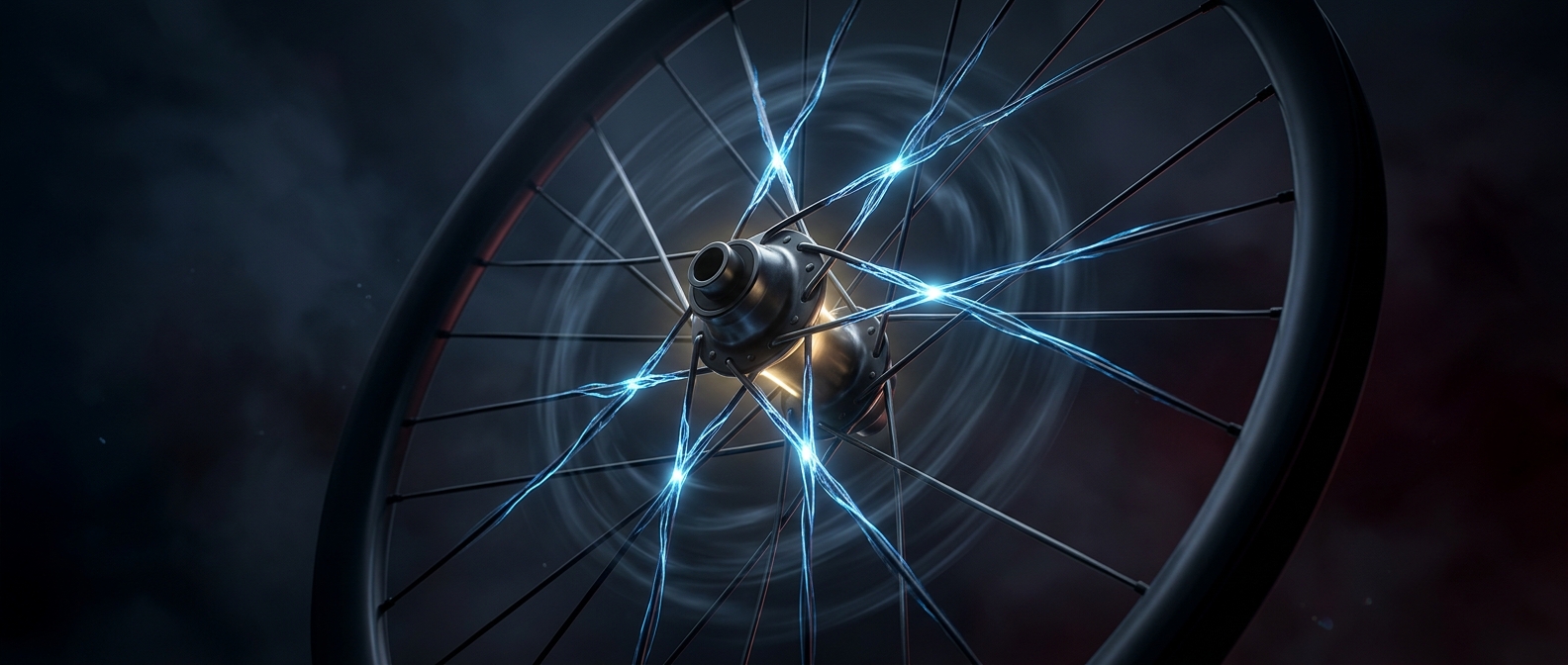
How crossed spokes carry turning force
A hub does not simply spin inside a wheel: it must make the rim turn with it. In a crossed pattern, each spoke runs from a hub flange to a rim hole that is offset around the wheel. That diagonal gives the spoke a small sideways, or tangential, pull as well as its pull toward the rim.
When the hub applies torque—whether from pedaling or braking—the spokes’ tangential pulls pass that force to the rim. Some spokes become more tensioned while others lose tension slightly. Since spokes can pull but cannot push, the wheel’s strength comes from keeping them under tension; the spoke group that tightens carries more of the added load.
Why the pattern matters
A radial spoke runs nearly straight from hub to rim, with little tangential offset. It can help hold a wheel’s shape, but it offers much less leverage for transmitting torque. Crossed spokes provide that leverage, which is why wheels that receive drive or braking force through the hub are generally built with a pattern suited to carrying it.
The spokes also help the wheel support loads: as the rim flexes slightly under weight or road impacts, spoke tensions shift. They are not tiny rigid struts, but tensioned cables working together with the rim and hub. The crossing is therefore more than a visual pattern—it gives the spokes the direction needed to turn the rim as well as keep the wheel assembled.