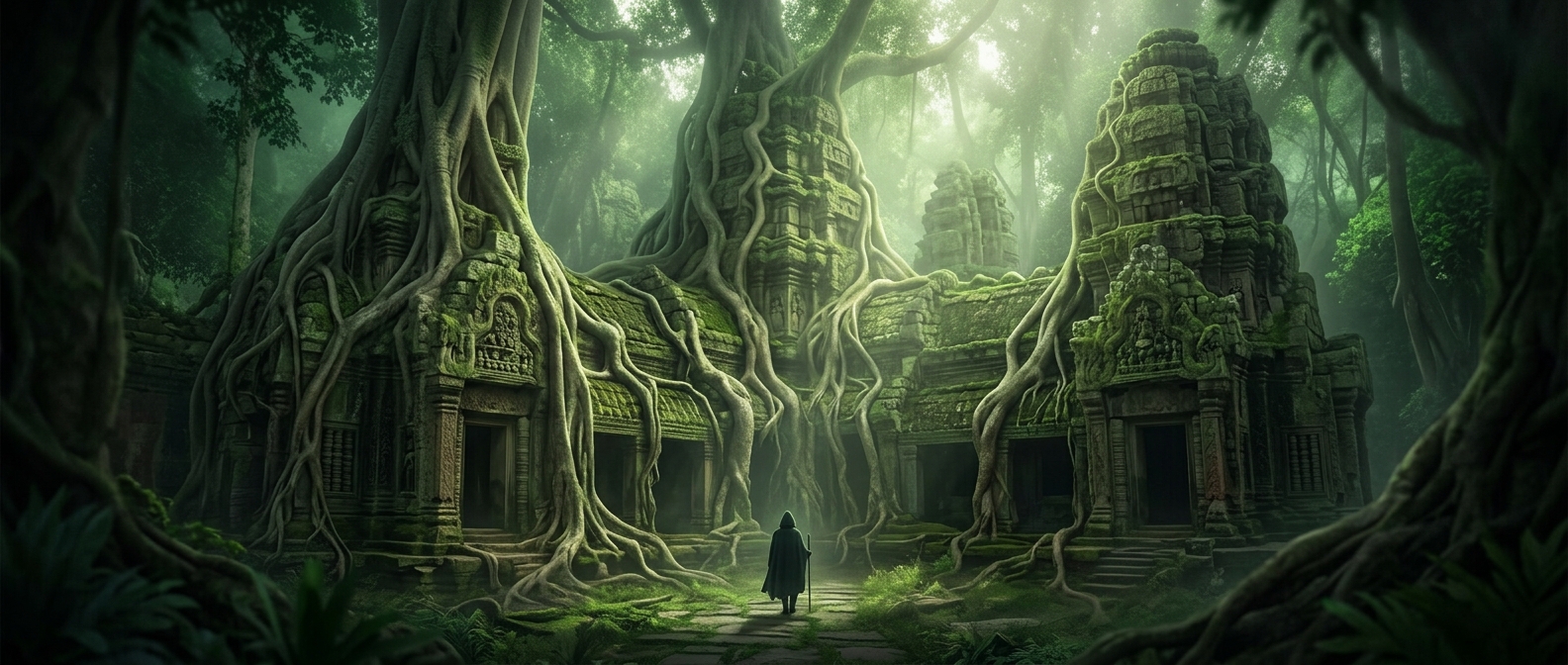
How Trees Took Hold at Ta Prohm
At Ta Prohm, part of Cambodia’s Angkor temple complex, the trees did not simply push up through intact stone. Seeds can settle in cracks and ledges, carried there by wind or animals. Once a seed sprouts, its roots grow into gaps in the masonry in search of water and nutrients. As the tree thickens, the roots can press against blocks, shift them, or bind loosened stones together.
That two-sided effect is why the roots are more than a dramatic backdrop. A tree may help hold a section of wall in place even as its growth gradually strains the same structure. Removing a mature tree can therefore be risky: if roots have become interwoven with the stones, taking them away could leave masonry unstable.
A Ruin Preserved in Tension
Ta Prohm was built as a religious complex during the Angkor period. Over the centuries, buildings were abandoned or maintained less intensively, while vegetation spread through the site. Later preservation has had to balance two goals: protecting the stonework and retaining the landscape that has become part of the place’s identity.
The result is not a temple untouched by time, but a carefully managed ruin where nature’s growth and human conservation meet. The striking detail is also an engineering problem: every root that appears to hold a wall in its embrace may be helping preserve it—or slowly pulling it apart.