How ancient DNA survives in a living person
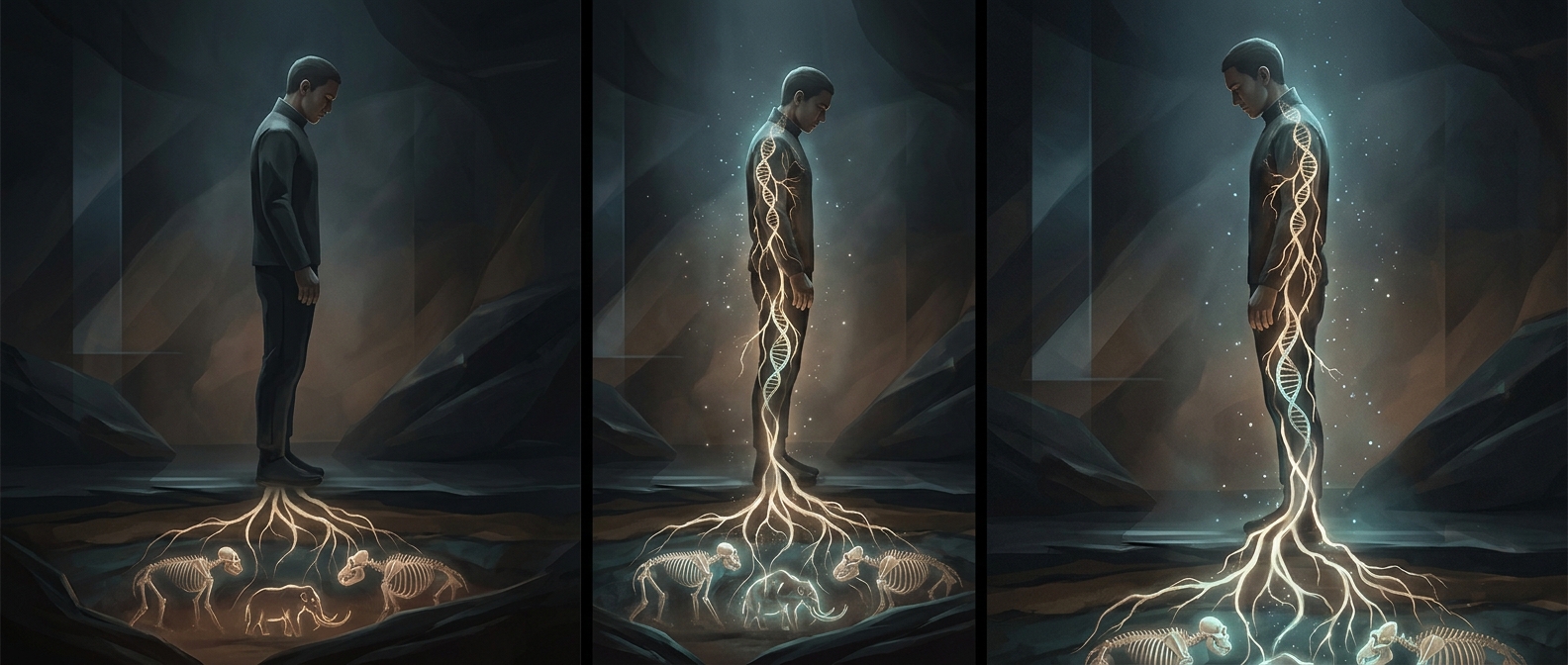
When a Neanderthal ancestor had children with an ancestor of modern humans, some Neanderthal DNA entered that family line. It did not remain as one intact package. In each generation, parents pass on shuffled portions of their chromosomes; over many generations, this mixing breaks inherited DNA into smaller stretches. A person today may carry a small collection of those stretches without having a recent Neanderthal ancestor.
The percentage describes the share of a person’s DNA that can be traced to Neanderthal ancestry, not a set of traits they must display. People inherit different stretches, so two people with similar backgrounds can carry different Neanderthal variants. The amount also varies across populations and family histories; the familiar estimate is a broad average, not a personal measurement.
What those fragments can—and cannot—tell us
A DNA variant can influence how a biological process works, but its effect depends on the rest of a person’s genes and on their environment. Some inherited Neanderthal variants have been associated with differences in traits, including aspects of skin or hair biology. That does not mean a person’s appearance can be read directly from their ancestry percentage, or that any one variant determines a visible trait.
The more revealing point is how inheritance works: ancient DNA can persist as scattered fragments, even after the people who first carried it disappeared. A small fraction of a genome can therefore preserve a trace of contact between populations far back in human history.