How Nabokov’s collecting trips gave Lolita a road map
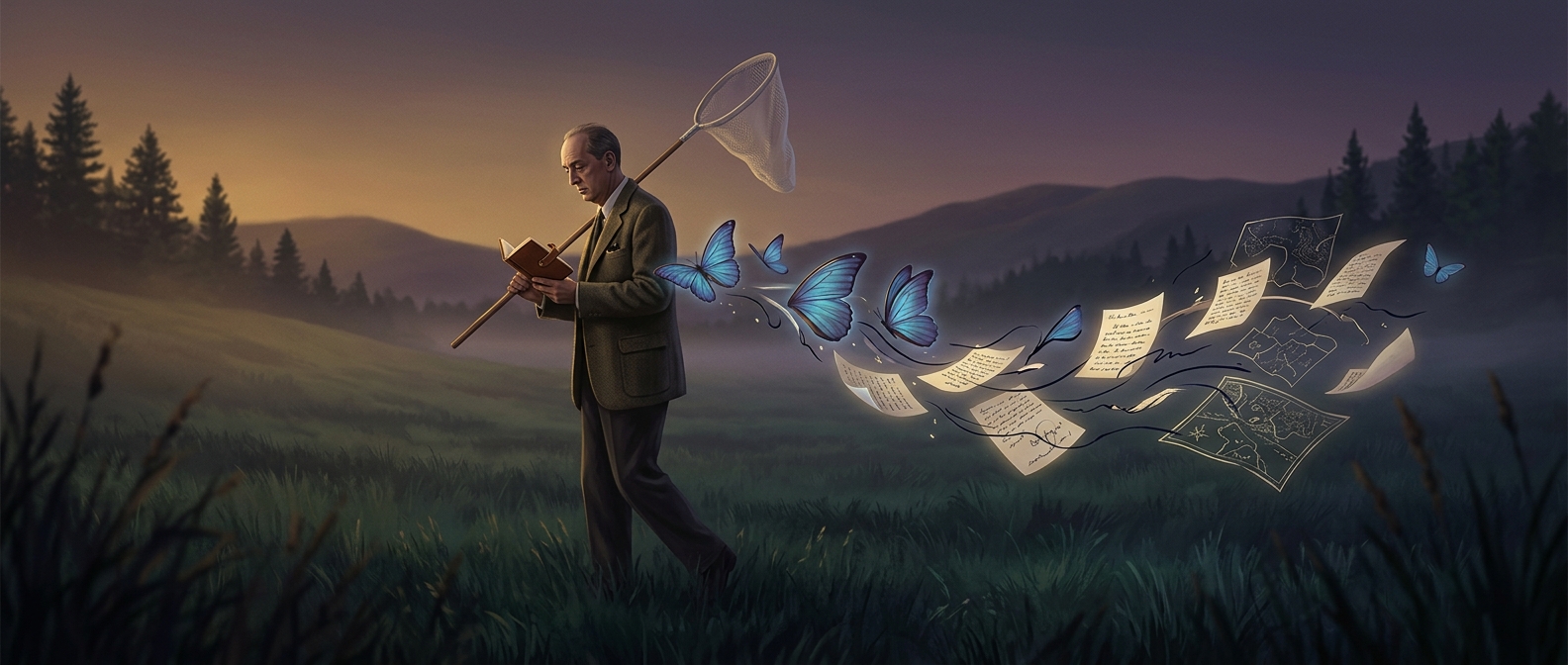
To collect butterflies, Nabokov had to travel through landscapes slowly and attentively. A promising specimen might send him off the highway into a field or along a mountain road; the work meant noticing where one terrain gave way to another and what could be found there. Those journeys gave him firsthand familiarity with the distances, roads, and changing scenery of the American West—not just a view from a passing car.
That knowledge mattered to a novel built around a long drive. In Lolita, Humbert and Lolita move through the United States, and the changing places they pass help give the journey its shape. Nabokov’s travels supplied a store of observed geography that could make a fictional itinerary feel grounded in actual travel, rather than in a vague idea of “the West.”
Observation, not a travel diary
The connection is best understood as an overlap between two kinds of attention. The collector looks for distinctions: a different habitat, a change in elevation, a particular roadside environment. The novelist can use that same close looking to make a route legible through concrete shifts in place. A landscape becomes more than backdrop when the reader senses that it has been noticed in detail.
Nabokov’s real trips were not the novel’s itinerary copied onto the page. Instead, they offered geographical experience he could reshape for fiction. The result is a road story whose movement across the country carries the texture of places encountered on the ground—and whose author had learned to read a landscape one stop at a time.