How String Turns Rubik’s Magic Into a Folding Puzzle
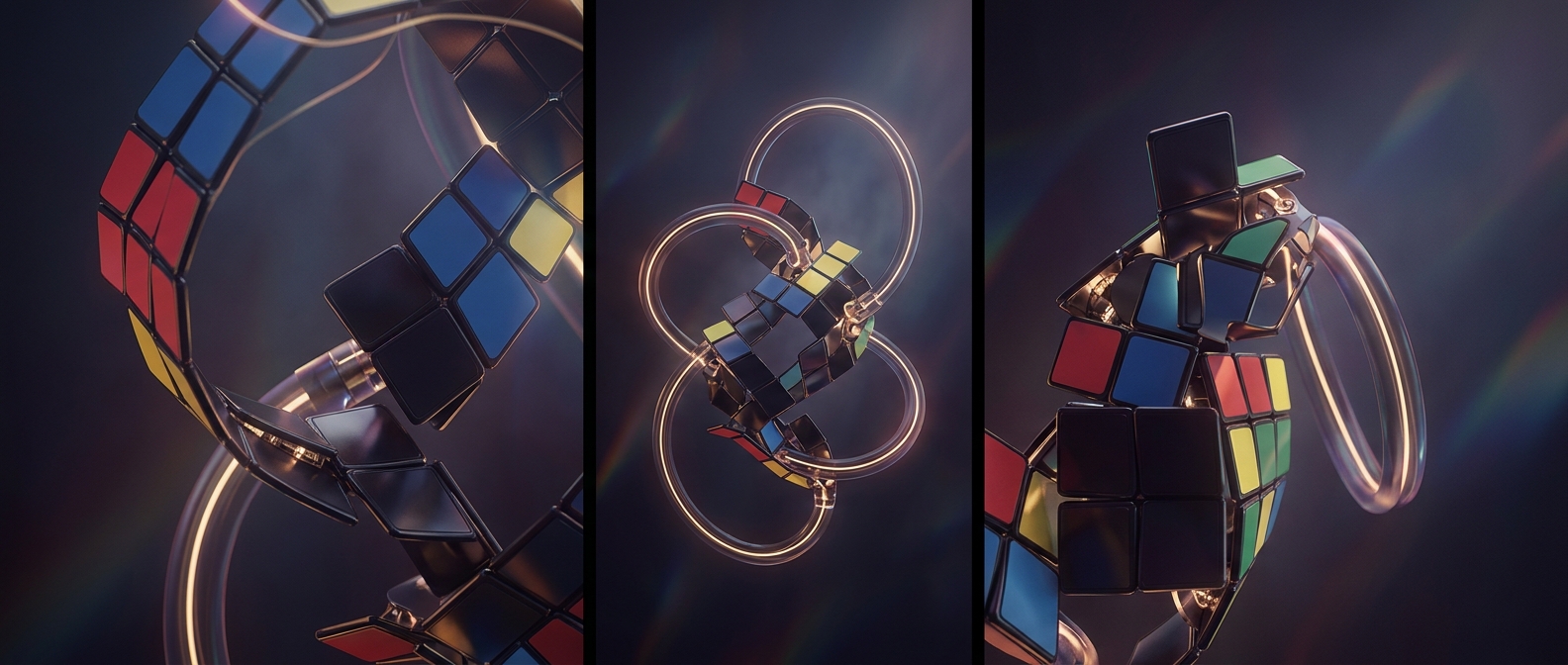
Rubik’s Magic looks like a set of flat, square panels, but the panels are not joined by ordinary hinges. A loop of string runs through openings in the tiles, linking them while leaving enough slack for the tiles to pivot and turn over. The string is both the connector and the flexible part of the mechanism.
The Loop Has to Move, Not Just Hold
As you fold the puzzle, neighboring panels change position: one may flip over while another swings around it. The string shifts through the openings as those movements happen. Because it forms a continuous connection, the panels can rearrange without each one needing its own rigid hinge or separate fastener.
That flexibility comes with a constraint. The string must be loose enough to let the panels move, but arranged so they stay connected and do not simply pull apart. The openings guide the string’s path, helping the tiles move through repeated folds while keeping the assembly together.
A Connector Becomes the Puzzle’s Mechanism
This changes what solving feels like. Instead of turning a central mechanism or sliding pieces along tracks, you manipulate a chain of panels whose movement depends on how the string routes between them. Each fold changes which panels can move freely and how the rest of the chain follows.
The clever part is easy to miss when the puzzle lies flat: the string is not merely there to keep the tiles from getting lost. Its movable loop is what makes repeated flipping and folding possible—letting a connected set of rigid squares behave like a compact, shape-changing puzzle.