Four elements as a map of the inner life
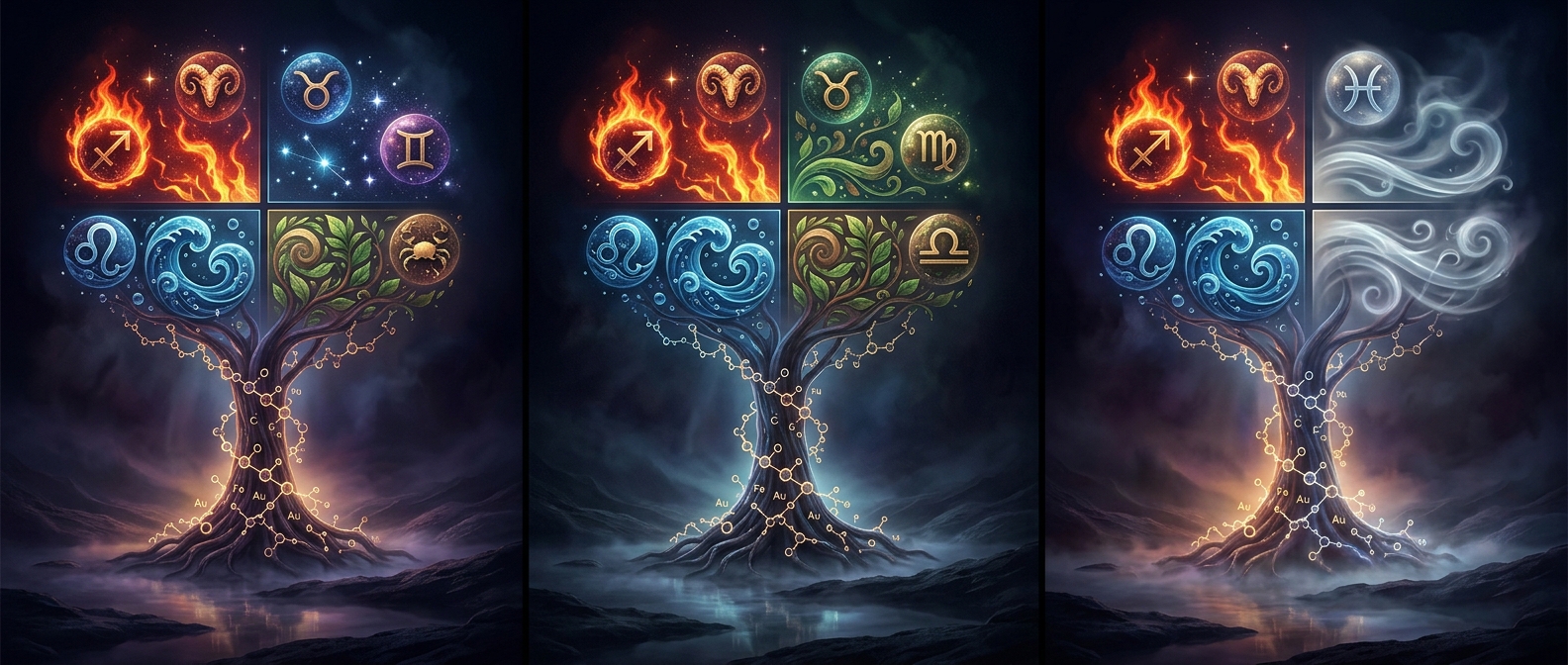
In Franz Bardon’s esoteric system, fire, water, air, and earth are not simply substances in the physical world. They are principles meant to describe forces within a person and the wider spiritual cosmos. This turns the ancient four-element scheme into a kind of metaphysical anatomy: the elements explain not just what the world is made of, but how character and experience are organized.
Each element has a distinct role
Bardon assigns each element a stable set of qualities. Fire is associated with expansion, heat, and activity; water with contraction, coolness, and receptivity. Air mediates between opposing forces, while earth gives them form and stability. These are symbolic properties within his occult teaching, not claims about the scientific behavior of the elements named after them.
The scheme matters because it treats the elements as interacting forces rather than isolated labels. A person’s inner life, in this view, can be understood through their balance and combination. A quality such as forcefulness might be read as fiery, while steadiness might be earthy; neither quality is meant to explain a person by itself.
A system for interpreting and training the self
Bardon’s framework also gives practitioners a vocabulary for self-observation. Instead of treating a habit or reaction as an unexplained trait, they could ask which elemental principle it expressed and how it related to the others. The theory thus links a cosmic picture of reality to personal discipline: understanding the elements is presented as a way to understand and shape oneself.
Its significance lies in that bridge between cosmology and character. The four elements become more than a classification of nature—they form a symbolic map for thinking about how inner forces combine to make a human being.