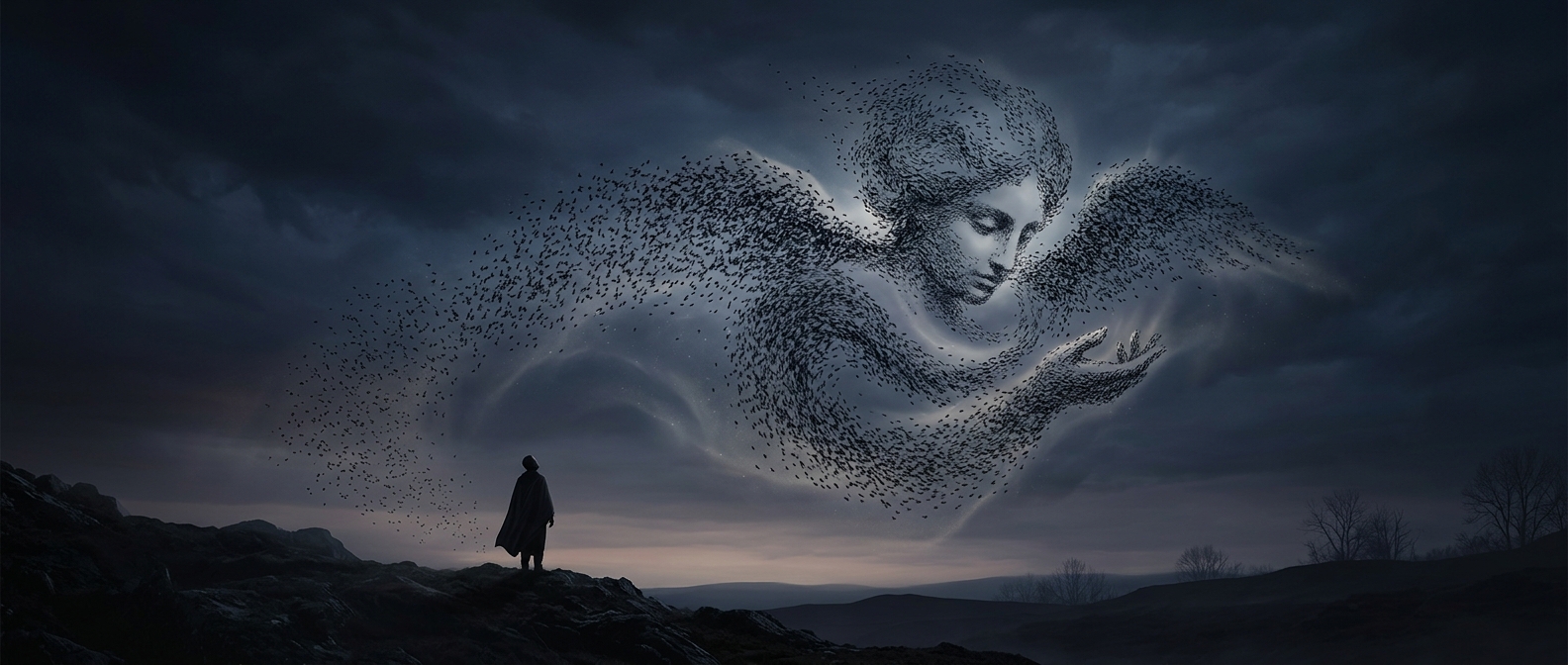
How a flock moves like one body
A starling murmuration can seem to bend and ripple as a single cloud, but there is no bird directing the whole display. Each starling adjusts its flight in response to nearby birds—changing direction or spacing as its neighbors do. Those small, rapid reactions spread through the flock, so a turn begun in one part can travel across thousands of birds like a wave.
The effect is especially striking because the flock has no obvious outline. Birds continually shift position, yet they keep enough distance to avoid collisions while staying close enough to respond to one another. From the ground, the result looks coordinated on a scale far larger than any one bird’s view.
From mysterious pattern to natural behavior
Before people understood how collective animal movement could arise from many local responses, a murmuration offered little visible explanation for its sudden changes. Its shifting shapes could look like a message written across the sky. In some interpretations, such patterns were taken as omens from the gods, including signs of approaching doom.
That reading made sense within a worldview in which unusual events in nature could carry warnings. The flock’s movement was real; the supernatural message was an interpretation of it. Seeing the pattern as a consequence of birds reacting to nearby flockmates replaces a hidden director with a process that can unfold through ordinary behavior.
A warning-shaped cloud
The same movement that once invited ominous explanations still makes the flock look purposeful: a dark mass can surge, split, and reunite without any visible leader. The striking lesson is that complex, coordinated motion does not always require a planner. Sometimes it emerges from many individuals responding to what is immediately around them.