How the Brain Assigns a Voice to a Face
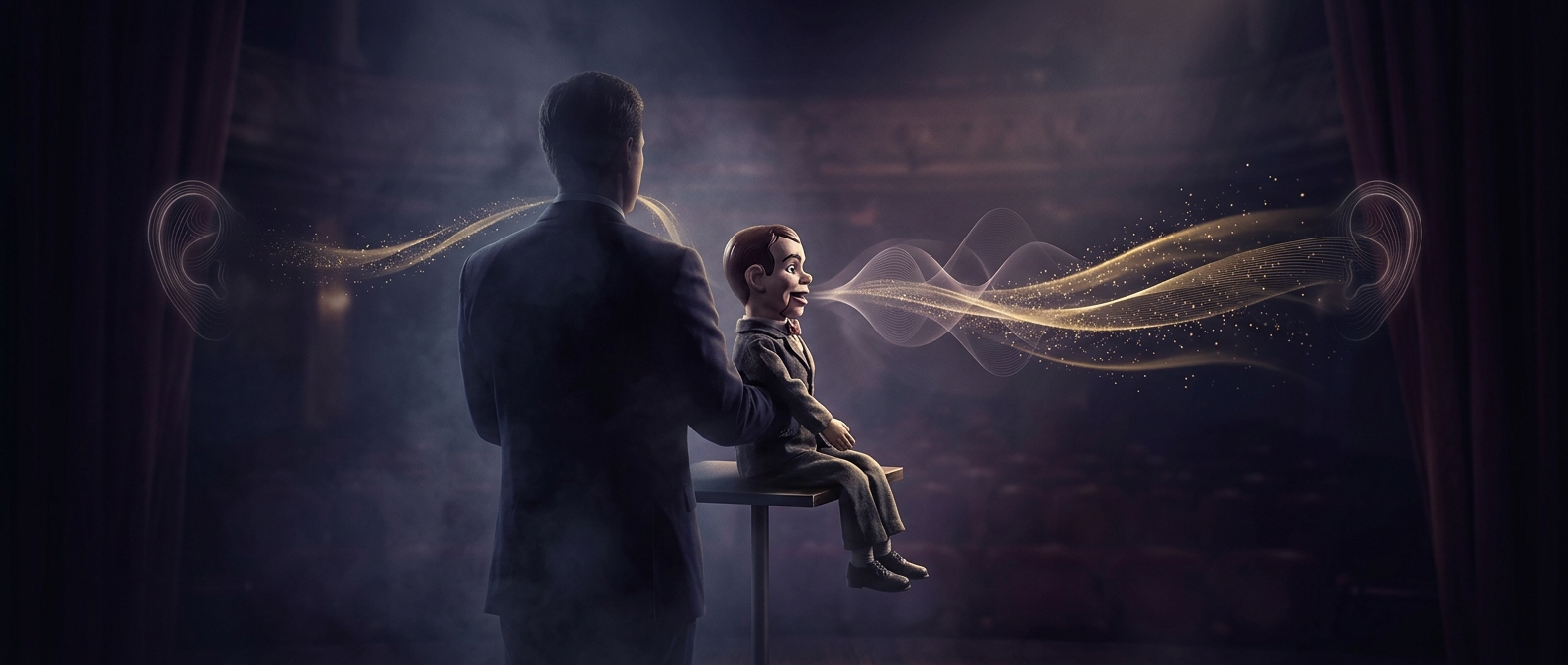
When a voice and a visible character appear together, the brain tends to treat them as parts of one event. It does not wait for the puppet’s mouth to move: the voice is already meaningful, and the puppet is the most obvious thing in view that could belong to it. This is a form of source attribution—the mental process of deciding where a sound came from.
Why Stillness Does Not Break the Illusion
Speech carries clues that it was produced by someone with a purpose. A sentence has words, timing, and emphasis; listeners automatically interpret those patterns as communication from a speaker. In ordinary conversation, a moving mouth helps confirm who is talking. But mouth movement is supporting evidence, not a requirement. If the sound and puppet are presented together, the brain can connect them without that cue.
The puppet’s design can strengthen the connection. A face gives viewers a ready-made target for attention, while a voice supplies the missing action: it appears to make that character speak. The audience may then read pauses or changes in tone as reactions, even though the puppet has not visibly responded.
The Mind Supplies the Intention
Once the voice is assigned to the puppet, listeners often go a step further. They interpret the words as the character’s thoughts or intentions rather than as sound produced elsewhere. This is not a conclusion drawn from the puppet’s actual movement; it is the mind’s effort to make a coherent scene out of a voice and a visible character.
That is why a motionless puppet can still seem present in a conversation. A voice gives the character an apparent point of view, and the audience does the rest—treating a still face as the speaker behind the words.