A face rebuilt one frame at a time
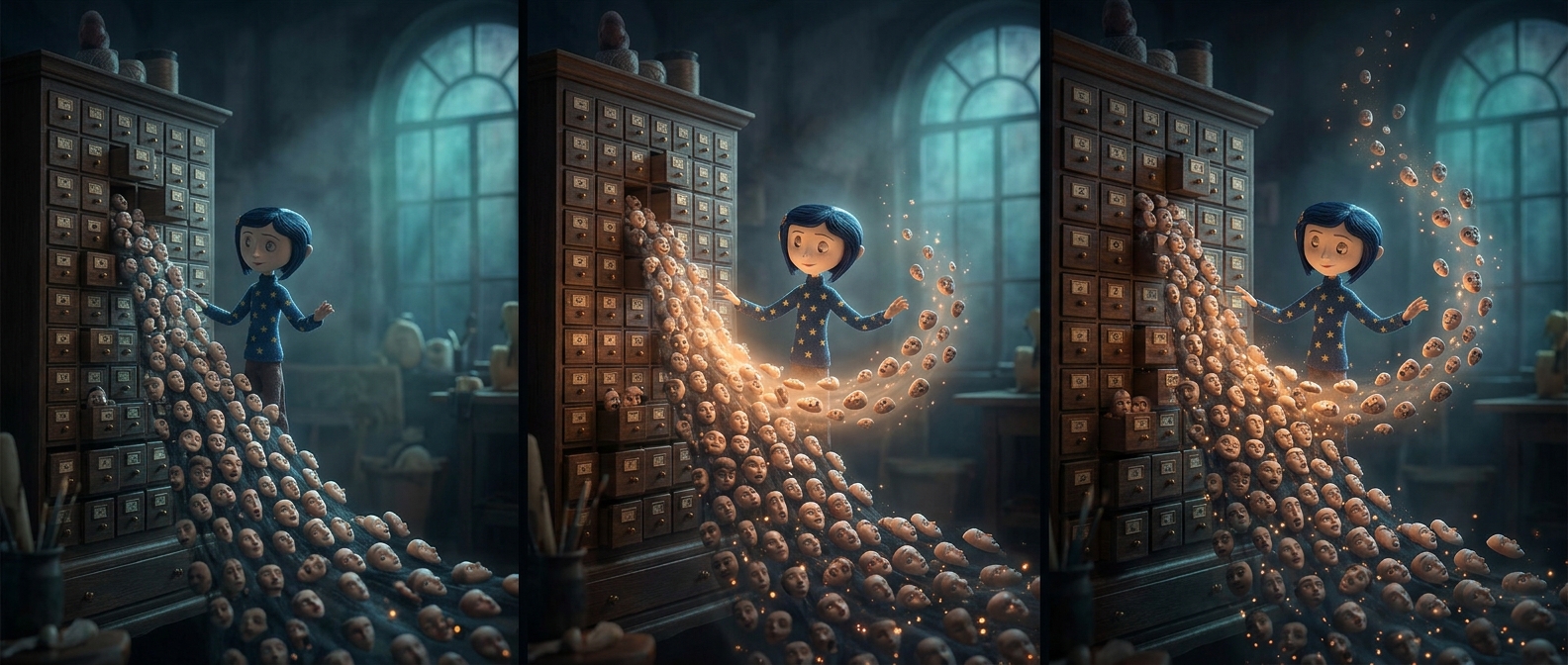
In Coraline, a change in expression was not simply a tiny movement of a puppet’s mouth or brow. The animators used replacement animation: they swapped 3D-printed face pieces between frames, photographing the puppet after each change. Played in sequence, those still images make the face appear to move.
The face was divided into upper and lower sections. Because each section could be changed independently, animators could pair an upper-face piece with different lower-face pieces—and reuse a piece in more than one pairing. That modular setup produced 207,336 possible combinations, giving the team a broad range of expressions to choose from.
Why split the face into pieces?
A character’s eyes and mouth do not always convey the same emotion. Coraline might look worried while speaking, or keep a steady gaze as her mouth changes shape. Separate upper and lower pieces let animators adjust those parts independently instead of choosing from a small set of complete, all-in-one faces.
The system also made expression a frame-by-frame design decision. Animators could select the face that best fit a particular moment, then choose another for the next photographed frame. The 207,336 combinations were possibilities, not 207,336 expressions that had to appear in the film. The practical payoff was control: a small change in a paired set of pieces could make a puppet’s face feel responsive without requiring a mechanically moving face.