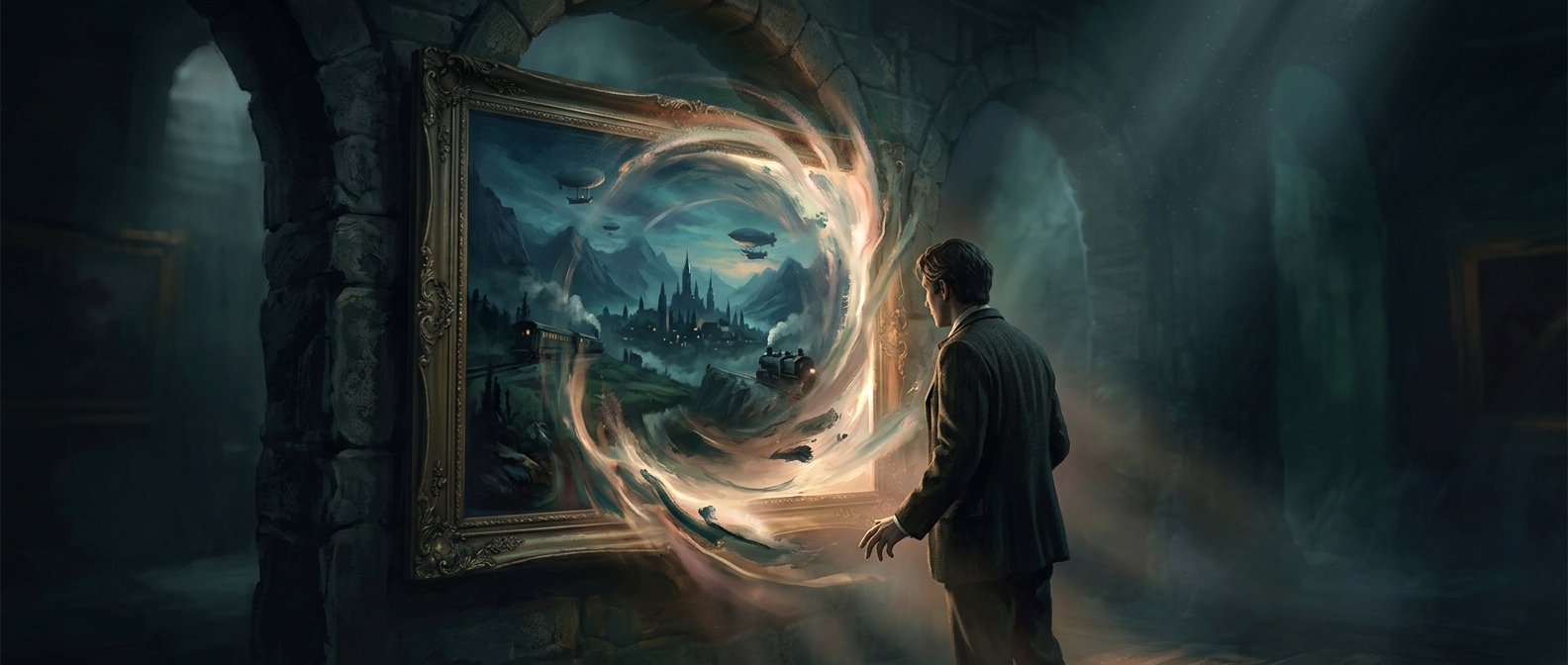
How a Painted Wall Acquires Depth
A convincing illusion of a passage depends on the same visual cues your brain uses to judge ordinary rooms. Parallel edges appear to converge toward a distant point; nearby surfaces overlap what lies behind them; and shadows suggest that one plane sits farther back than another. On a flat canvas, an artist can arrange all three cues to imply an opening where there is only a painted surface.
The trick is strongest when the painted geometry agrees with the room around it. A floor pattern that seems to continue through the wall, or a shadow that matches the direction of nearby light, helps the imagined passage feel connected to the real space. The painting is not physically deep, but its visual cues invite the brain to interpret it as depth.
Why the Viewpoint Matters
Perspective is built for a particular viewing position. From that spot, the painted lines and proportions align into a plausible corridor or doorway. Move sideways, however, and the apparent opening does not shift like a real one: its edges remain fixed on the wall, and the perspective can begin to look distorted. That mismatch reveals the canvas as a surface.
This limitation is also what makes the effect useful. A designer can make a narrow or blank wall seem to continue into a larger space without moving a single brick. The “passage” works as an architectural suggestion—convincing from the intended angle, and an illusion the moment the viewer tests it by walking past.**