A spacecraft had to fit a city, not a runway
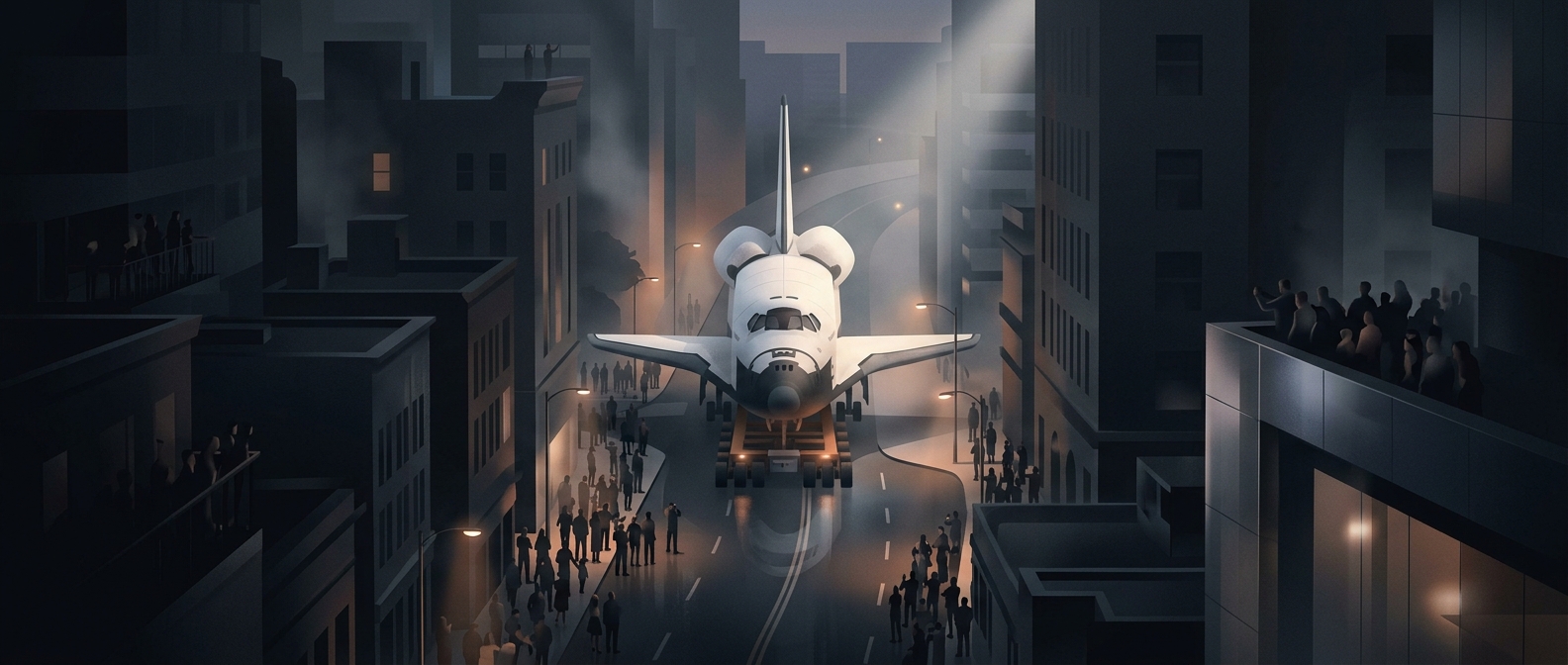
After its flying career ended, space shuttle Endeavour still had to reach its permanent home at the California Science Center. The route from Los Angeles International Airport ran through ordinary city streets, where the shuttle’s wings and tail could not simply be squeezed past whatever stood in the way.
Crews set the orbiter on a purpose-built transporter. Moving it slowly helped keep the enormous load stable and gave the team time to manage tight turns and watch clearances. The challenge was not just whether Endeavour could pass beneath an obstacle, but whether its broad wings could clear it at the same time.
The route became part of the engineering
Before the move, crews prepared the streets for the shuttle’s passage. Trees were trimmed or removed, and overhead wires were taken down where they crossed the route. Those changes turned a familiar road into a temporary transport corridor: every corner, curb, and obstruction mattered to a machine designed for flight, not urban traffic.
That is why the transporter’s crawl was useful, not merely theatrical. At walking speed, crews could pause and adjust rather than risk scraping the orbiter against a building or street fixture. The shuttle’s final journey depended as much on route planning and coordination as on the vehicle carrying it.
A landing turned into a public passage
Endeavour’s arrival also made the city’s infrastructure visible in an unusual way. Streets are built to move cars and trucks; this trip required workers to adapt the route around an object far wider and more delicate than ordinary traffic. For spectators lining the streets, the shuttle’s last mission unfolded not across a sky but block by block, through the spaces Los Angeles had to temporarily make for it.