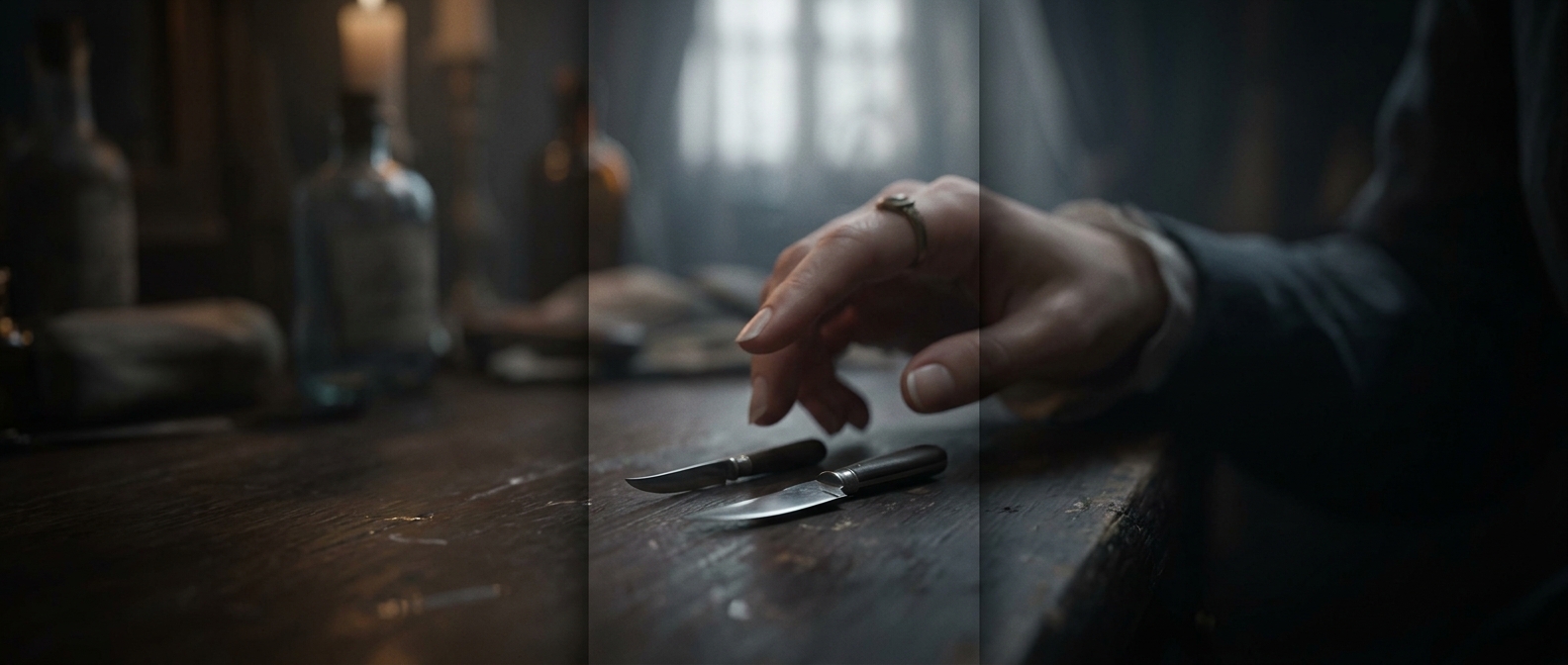
Trimming a Nail With a Blade
A fingernail is a hard plate of keratin, the same material found in hair, attached to sensitive skin underneath. To shorten it with a small knife, a person had to remove the free edge—the part extending beyond the fingertip—without letting the blade slide onto the skin or split the nail. That called for small, controlled cuts rather than one forceful slice.
The task was especially awkward because nails are curved and fingers are close together. A blade suited to ordinary cutting could be sharp enough, but it was not shaped to guide itself around a nail. The user had to supply that precision by holding the finger steady and judging each cut.
A Tool Designed Around the Task
Dedicated nail clippers changed the mechanics. Their paired cutting edges meet when the handles are pressed, turning a squeeze into a short, repeatable cut. The leverage of the handles helps apply force at the nail’s edge, while the compact shape makes it easier to trim without maneuvering a long blade beside the fingertip.
That did not make every cut effortless: nails can still crack or be cut too close. But it shifted some of the burden from the user’s knife skill to the tool’s shape. The contrast is a useful reminder that a familiar grooming task once depended on adapting a general-purpose blade to a delicate, curved surface.