Why a taller glass can seem to hold more
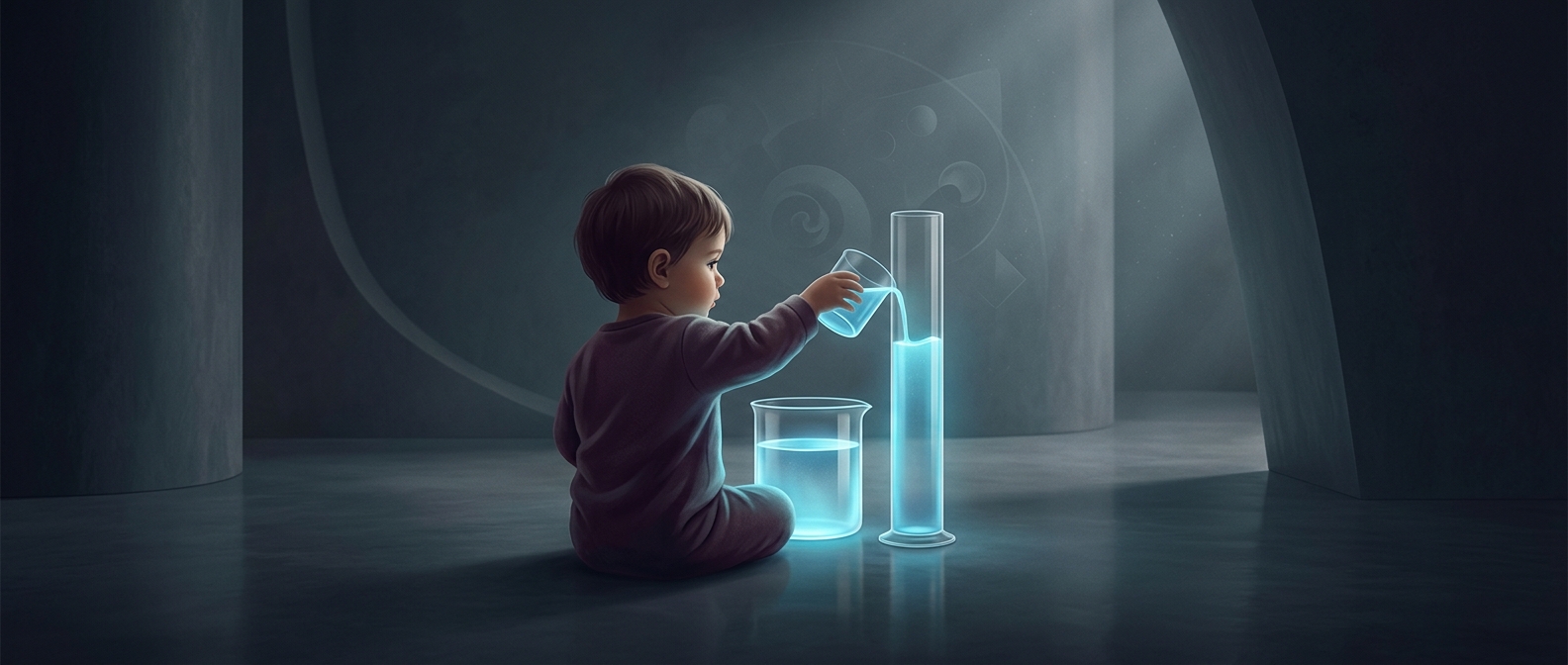
In a classic child-development task, an adult pours liquid from a short, wide container into a tall, narrow one and asks whether the amount has changed. Many young children say the taller glass holds more. The new shape makes the liquid’s height an especially vivid clue, while the narrowing of the glass is harder to factor in.
The challenge is not simply seeing the water. It is coordinating two dimensions at once: the level rose, but the container became narrower. An adult can mentally reverse the pour—picture the water returning to its first container—and use that imagined action to check the amount. A young child may focus instead on the most noticeable change: the higher waterline.
Learning to look beyond the visible change
Developmental psychologists call this kind of understanding conservation: recognizing that a quantity stays the same when its appearance changes but nothing has been added or removed. The same reasoning can be tested with reshaped clay or objects spread farther apart. In each case, a visible feature changes, and the child has to distinguish that change from a change in quantity.
With experience and development, children become better at coordinating the relevant clues and considering how an object or substance could be returned to its original form. Their answers can also depend on how a question is asked or on how familiar the materials are, so one response is not a complete measure of a child’s thinking.
The task makes an ordinary mental operation visible: seeing a higher waterline is easy; realizing that height alone cannot tell you how much water there is takes a more flexible way of reasoning.