Turning 3-D movement into comic-book motion
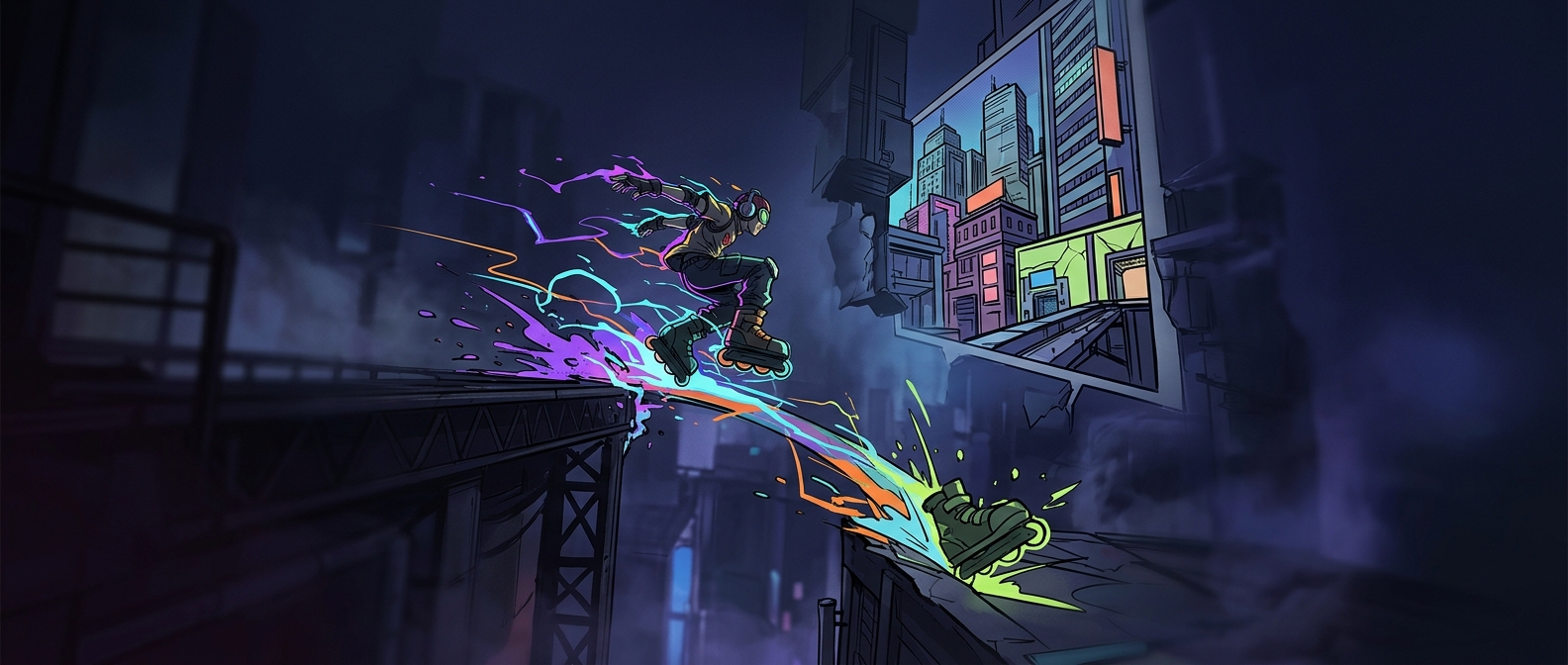
Cel shading gives three-dimensional models a flatter, illustrated appearance. Instead of smoothly blending light across a character, a game can use a few distinct bands of color, then add dark outlines to make shapes read like inked drawings. The characters still move through a 3-D world; the rendering makes that world feel closer to a comic than to a realistic scene.
That combination suited Jet Set Radio’s fast-moving skaters. Players had to pick out characters, obstacles, and routes while gliding through busy city spaces. Strong outlines and simplified colors helped separate shapes at a glance, while the graphic look made the game’s graffiti-covered streets feel like one coherent visual world.
A style with a job to do
The effect was more than a decorative filter. A realistic treatment might have made the game’s exaggerated poses and vivid street-art imagery feel less unified. The cartoon-like rendering let characters, environments, and graffiti share the same visual language—and helped the game’s movement retain a lively, hand-drawn feel.
Jet Set Radio did not invent cel shading, but its striking use of the technique helped bring it to a broad video-game audience. Its influence can be seen in how later games treated stylized rendering not as a lesser substitute for realism, but as a deliberate design choice: a way to make a world instantly recognizable and easier to read in motion.