A talking board built for the parlor
The Ouija board emerged not from a secret religious order but from the late-19th-century business of selling novelties. In 1890, Baltimore businessman Charles Kennard organized a company to manufacture and market talking boards. The patent for the board was filed by Elijah Bond, a lawyer and inventor, and issued in 1891. The early product belonged to a booming market for parlor amusements, at a time when séances and communication with the dead were already popular subjects of public fascination.
That commercial setting matters: the board did not need to prove that spirits could speak. It needed to give a group of people a compelling way to try.
How a message appears
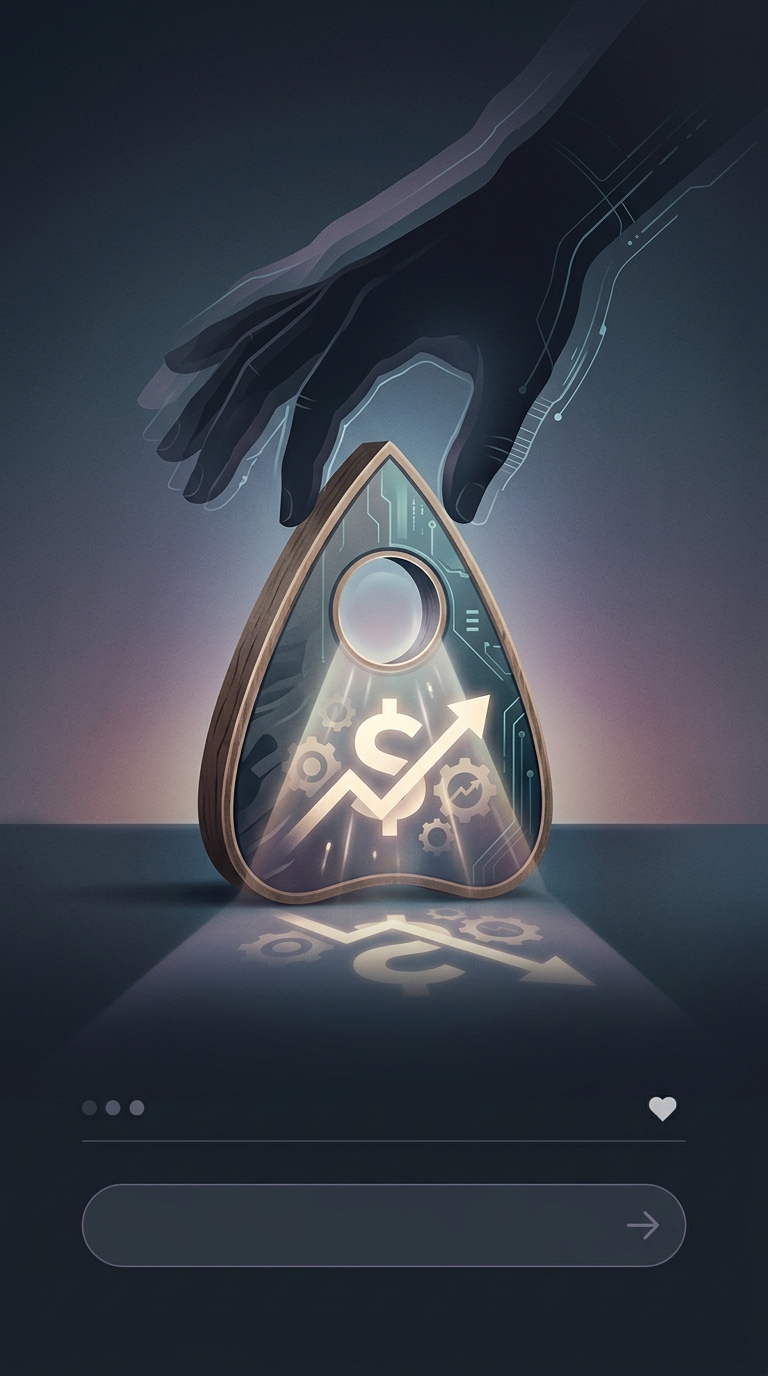
Players rest their fingers on a small, movable pointer called a planchette. As it glides across the board, its window passes over letters, numbers, or “yes” and “no,” spelling out responses. The movement can feel as though no one person is directing it, especially when several players touch the planchette together.
A familiar explanation for such movement is the ideomotor effect: people can make small, unconscious motions while sincerely feeling that they are not choosing to move. The shared pointer turns those motions into a visible answer, while the board’s layout makes the answer easy to read aloud.
A product shaped by its moment
The design joined two things that sold well together: a simple tabletop game and the era’s interest in spiritualism. Its rules were minimal, so a group could begin quickly; its lettered surface let ordinary movements produce an apparently deliberate message. That combination helped the board travel beyond any one séance circle and into living rooms as both entertainment and an invitation to wonder.
The striking twist is that a device associated with the supernatural was made legible as a consumer product: a board, a pointer, and a group of players whose tiny movements could become a conversation.