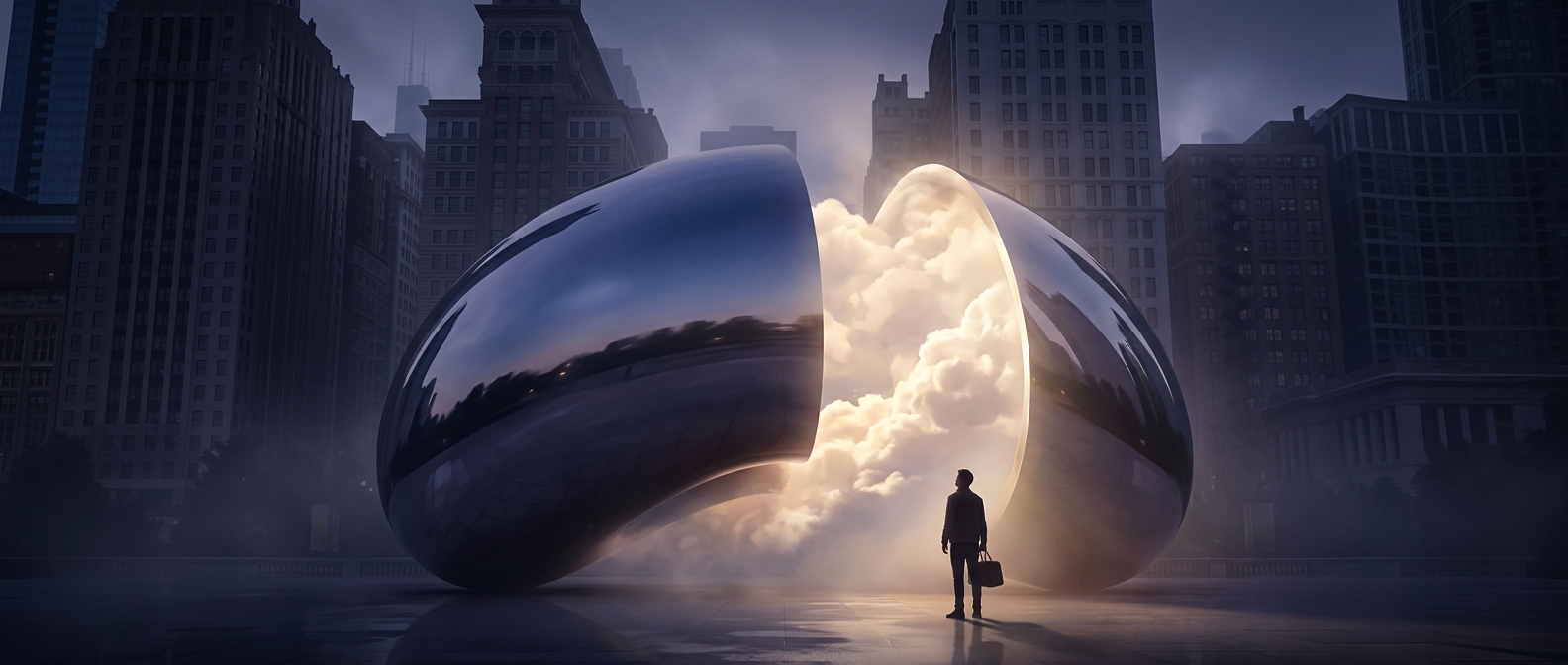
A mirror shaped by the city
Cloud Gate’s name points to what the sculpture does, not just what it looks like. Its curved, highly polished stainless-steel surface gathers reflections of the sky and the buildings around Millennium Park, then bends them into a shifting, distorted scene. As clouds move or visitors change position, the reflected image changes too. The sculpture acts less like a flat mirror than a lens made of metal.
Why the reflection feels like an opening
The form’s broad, rounded body and its arch make the reflected sky seem to continue through the sculpture. Walking beneath it brings the viewer into that visual effect: the surface curves overhead, while reflections of people and the plaza fold around the arch. The “gate” suggests passage, though it is not a doorway to another place. It is an opening created by reflection, framed by a solid object.
The polished exterior also connects the work to liquid mercury, whose surface can look smooth and fluid while reflecting its surroundings. That reference helps explain why the official name is more than a poetic label: it describes the sculpture as a meeting point between sky, city, and viewer.
From official name to local nickname
“Cloud Gate” is the artwork’s title; “the Bean” is the informal name its outline prompted. The two names capture different ways of seeing it: one emphasizes the changing world reflected on its surface, the other the familiar, beanlike silhouette. Both fit a sculpture whose appearance depends on where you stand—and what the city is reflecting that day.