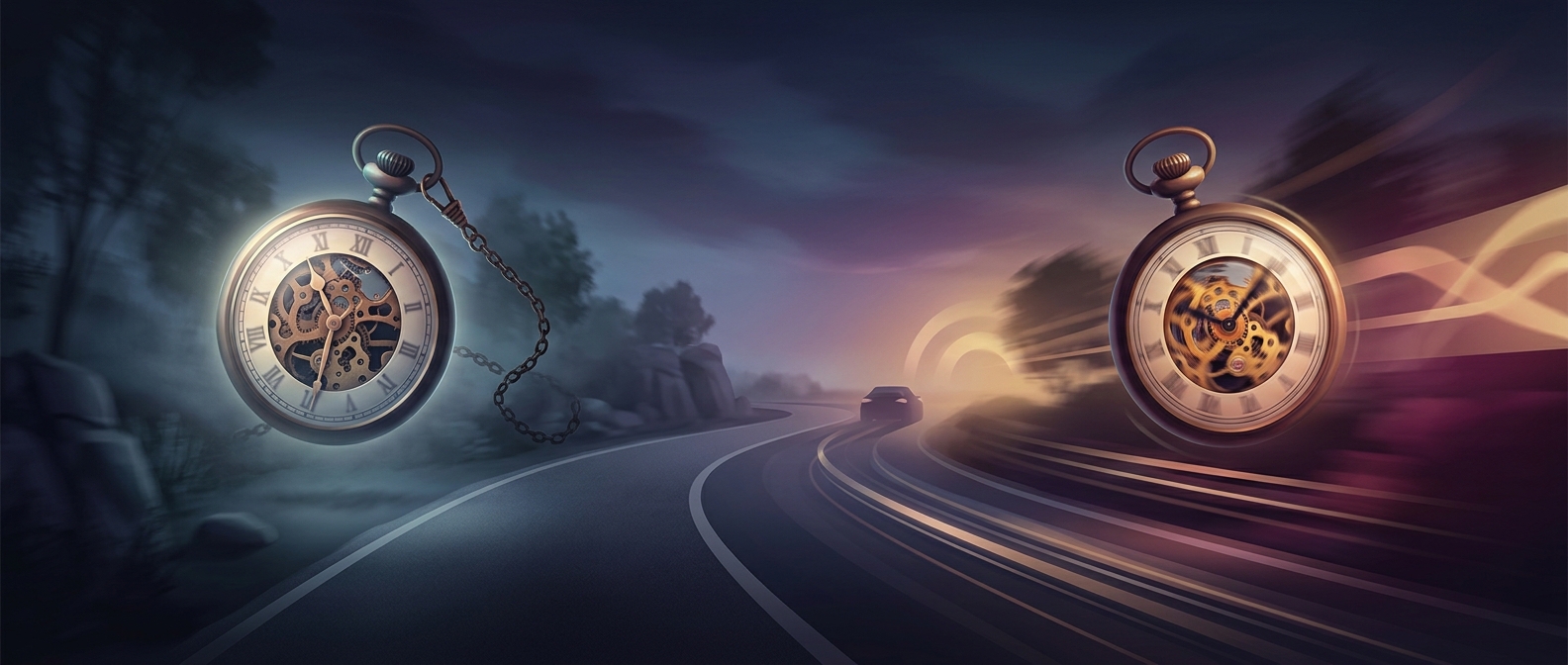
Why a Familiar Drive Can Shrink in Your Memory
On a new route, your attention has plenty to do: spot a turn, check a sign, recognize a landmark, and decide what comes next. Those moments give the trip distinct mental markers. On a familiar route, much of the driving runs on autopilot, so fewer details stand out for later recall.
That difference can change how long the drive seems when you look back. People often estimate elapsed time partly by reconstructing what happened. A trip with many memorable events can feel longer in retrospect; one that left a thinner trail of distinct moments can seem compressed. The road has not changed, but the remembered account has fewer chapters.
The Clock in the Moment Is Different
This is a judgment made after the trip, not necessarily a feeling that time sped up while you were driving. In the moment, attention, boredom, stress, and other factors can shape how slowly or quickly time seems to pass. Later, the mind uses remembered events as clues, and those clues may point to a different estimate.
The effect is not a literal measuring device: a familiar drive does not always feel shorter, and memory is only one influence on a time estimate. But it helps explain why a routine commute can seem to vanish when recalled, while an unfamiliar journey of similar length remains vivid. The memorable turn, unusual storefront, or wrong exit becomes a marker—and markers make a trip easier to remember as a stretch of time.