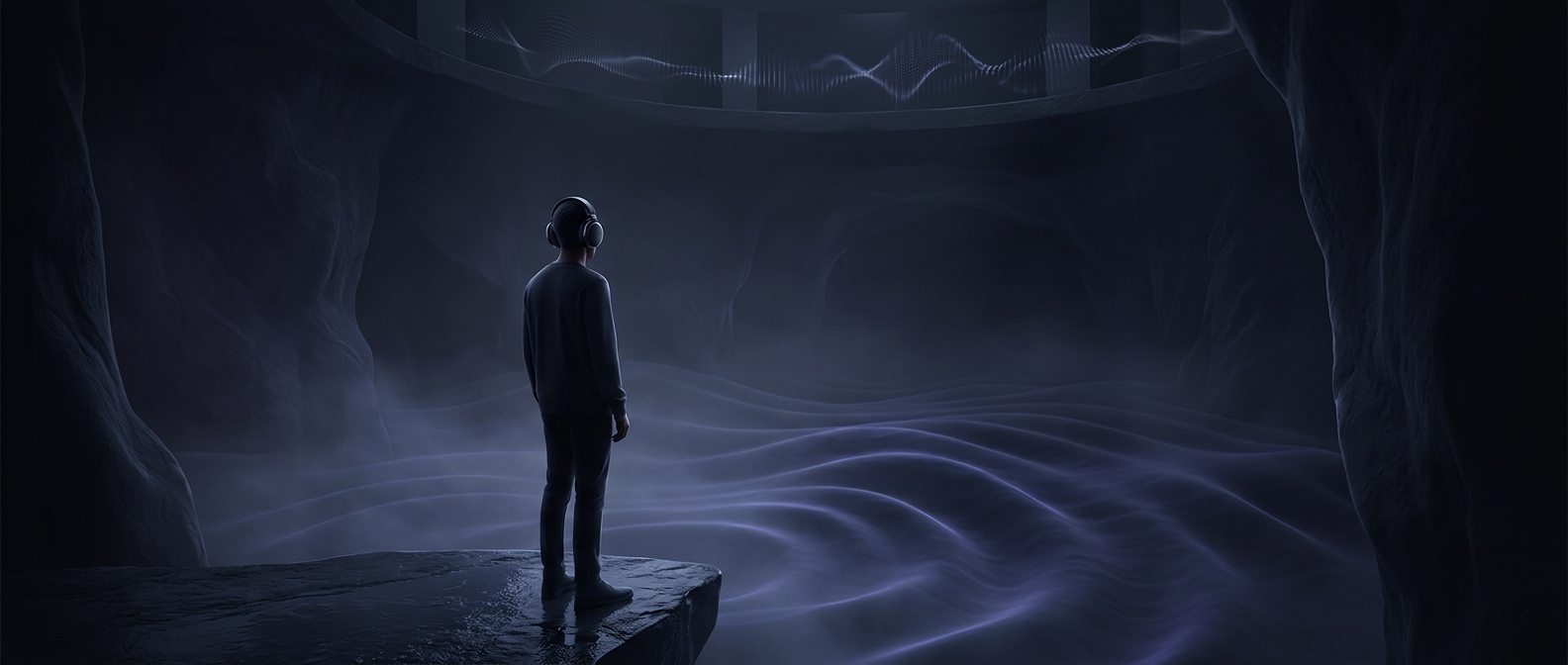
Why Very Low Notes Feel Different
A low-frequency sound moves the air in slow, widely spaced pressure waves. At 20 hertz, one cycle takes 1/20 of a second; in air, the wave is roughly 17 meters long. That scale helps explain why a deep sound can seem to fill a room rather than come from a sharply defined point.
The ear can register these slow vibrations, but it is less sensitive to low frequencies than to many midrange sounds. A faint 20-hertz tone may be inaudible even when a much quieter sound at a higher pitch is clear. The lower the pitch, the more sound energy is generally needed for it to seem equally loud.
When Sound Becomes Sensation
At sufficient volume, very low frequencies can be perceived not only through hearing but also as physical vibration. The eardrum and inner ear respond to pressure changes, while the body can feel strong vibrations through surfaces such as a floor or seat. This is why a deep note may register as a tremor or rumble before it becomes a distinct musical pitch.
The practical threshold is not a fixed line: it varies with loudness, the listener, and the sound environment. A system that can produce a 20-hertz signal does not guarantee that every listener will hear it as a clear note; sometimes the most noticeable evidence is the room itself responding.