Why a clock could tell sailors where they were
Latitude was comparatively manageable: the Sun’s height above the horizon changes with how far north or south a ship is. Longitude was harder because it depends on time. Earth turns 15 degrees each hour, so a sailor who knew the time at a reference port and the local time aboard could calculate how far east or west the ship had traveled.
The trouble was keeping that reference time. A pendulum clock that worked on land could lose or gain time as a vessel pitched, rolled, and changed temperature. Even a small error accumulated into a large mistake in longitude—enough to put a ship far from its intended route or landfall.
A prize for a practical solution
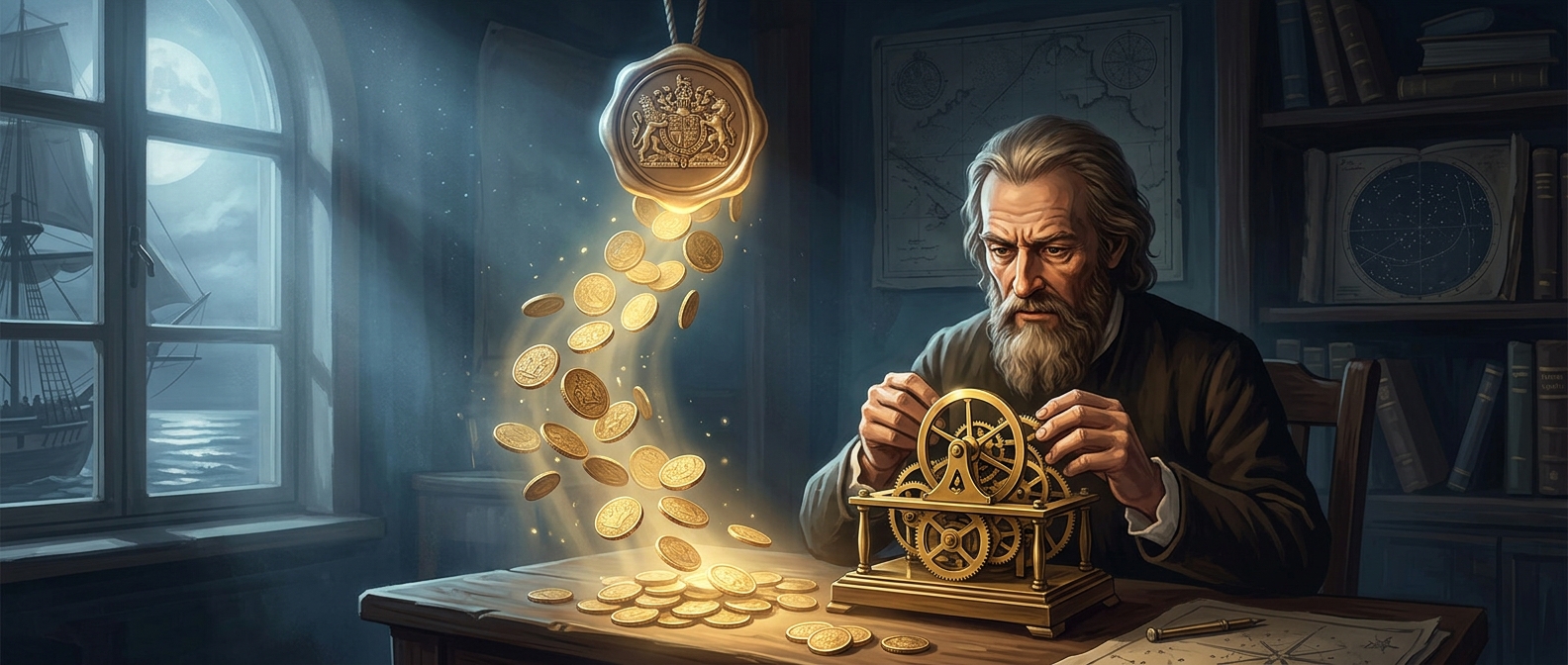
Britain’s Longitude Act of 1714 offered public rewards for methods that could determine longitude at sea, with the largest award reserved for especially accurate results. It did not prescribe a single invention. Instead, it set a demanding navigational problem and made a successful solution financially valuable.
One route was to make a clock robust enough to preserve a port’s time through a voyage. Another was astronomical: observe the Moon’s position against the stars and use tables to infer the time at a reference location. Both approaches aimed to supply the missing comparison between ship time and home time, but one required reliable machinery while the other required precise observations and calculations.
From timekeeping to safer navigation
A sea-going clock had to do more than run: it needed to keep its rate despite motion and changing conditions. That requirement drove the development of marine timekeepers, including John Harrison’s chronometers. A chronometer is a carefully engineered clock designed to keep accurate time aboard a ship; it let navigators carry a reference time with them rather than depend on seeing the Moon or stars.
Once the clock could survive the voyage, longitude became a calculation instead of a guess. The prize mattered because it turned a persistent hazard of ocean travel into a concrete engineering challenge—and because a dependable clock could help a ship know not merely where it had been, but which coast it was approaching.