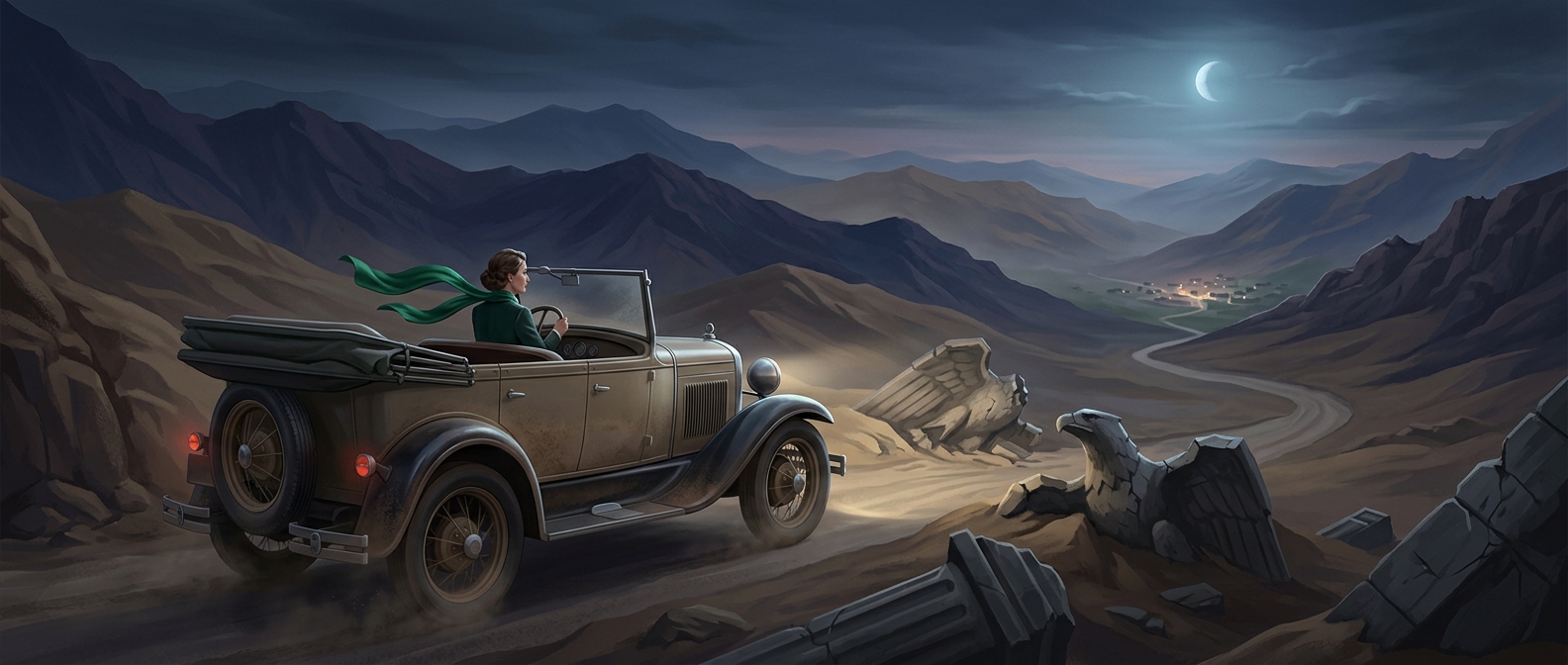
A road journey across a changing world
Annemarie Schwarzenbach’s drive from Geneva to Kabul was not a trip along one continuous, dependable highway. In the late 1930s, an overland route east crossed countries with different roads, border procedures, and terrain. A car made the journey possible, but it did not make it simple: travelers had to adapt as paved stretches gave way to rougher roads and as familiar European travel gave way to longer distances between services.
Schwarzenbach made the journey with fellow Swiss traveler and writer Ella Maillart. Their Ford convertible was both transport and a way to move at their own pace. The route carried them through southeastern Europe and Turkey toward Iran and Afghanistan, where distance itself became part of the experience: the landscape and the practical demands of travel changed from one stretch to the next.
The camera traveled with the journalist
For Schwarzenbach, travel and photography were closely connected. She was not only crossing unfamiliar places; she was making images as a photojournalist at a time when European politics were becoming increasingly dangerous. Her anti-Nazi work gave photography a public purpose: pictures could record people and conditions that readers far away might otherwise encounter only as headlines or abstractions.
That combination makes the journey more than a feat of driving. The car enabled access to places beyond the usual European itinerary, while the camera turned movement into documentation. The memorable detail is not simply that Schwarzenbach reached Kabul by car, but that she used the freedom of the road to observe and report on a world in upheaval.