Why the Scooter Fits the Trip
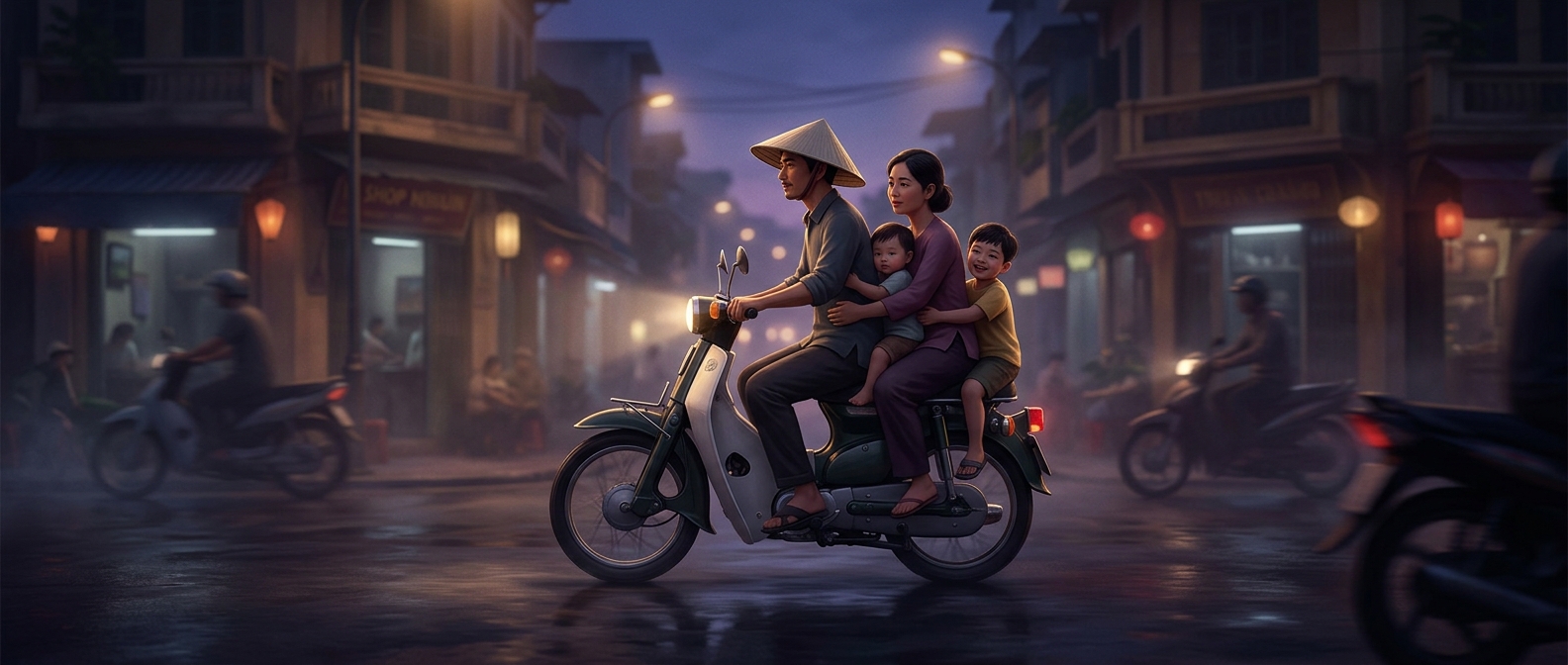
In many Vietnamese cities, a motorbike is more than a way to get to work: it is a flexible tool for errands and family travel. A scooter can move through streets where a car would be cumbersome, then be parked close to a shop or home. When one vehicle is already the household’s everyday transport, people may adapt it to carry passengers or a bulky purchase rather than arrange a separate trip.
Balance Is a Shared Job
A heavily loaded scooter does not stay stable by itself. The driver steers and manages the throttle and brakes, while passengers sit close together and try to remain still. A large object must be positioned and secured so it does not shift, block the driver’s view, or interfere with steering. Even then, extra weight changes how quickly the scooter can turn or stop; the driver has less margin for sudden moves.
What looks like effortless balancing is therefore a practiced response to familiar streets, not proof that any load is easy or safe. The vehicles, riders, and traffic all have to make room for one another, and a crowded lane can turn an ordinary errand into a careful exercise in timing and control.
A Street-Level View of Daily Life
For visitors, an unusually loaded scooter can seem like a spectacle. For the people making the trip, it may be a practical answer to a simple question: how do we get everyone—and the furniture—home in one go? The memorable sight reflects how urban travel is often organized around the vehicle people already have, rather than around a separate car for every task.