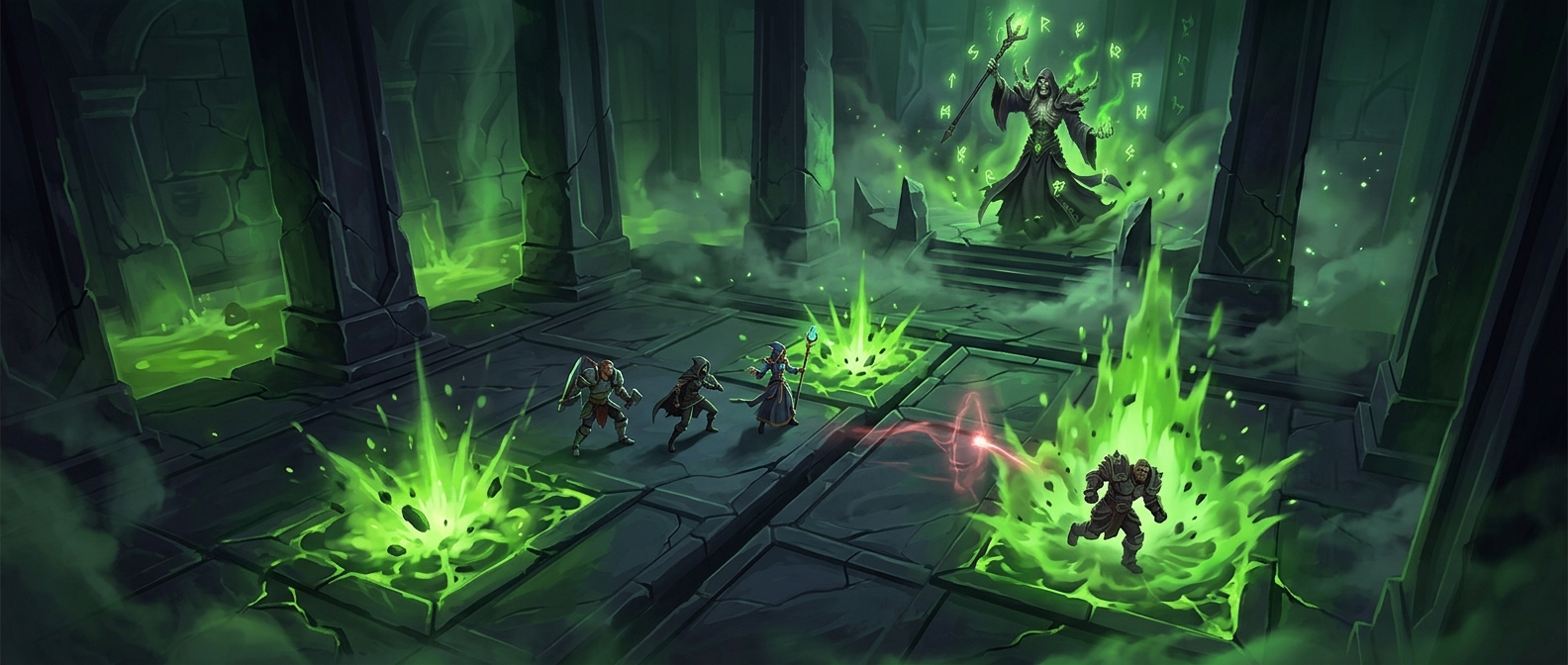
A raid encounter with a moving safe zone
Heigan the Unclean’s floor attack turned the room itself into a timing puzzle. Rather than finding one permanently safe corner, players had to follow a repeating sequence of safe areas, moving together as eruptions swept across the floor. A raid could know the pattern and still fail: each player had to reach the next area at the right moment, while keeping pace with 39 teammates.
Why the screen could disagree with the server
In an online game, your computer sends movement to the game server, which decides where your character is for purposes of combat. The picture on your screen is an estimate built from updates traveling across the network. When those updates arrive late, the two versions of events can briefly differ: your display may show you across the boundary, while the server still has you inside the dangerous section when the eruption resolves.
That gap made latency unusually visible. In many fights, a small delay might mean a missed attack or a late dodge. Here, the whole group’s survival depended on crossing a boundary on a shared beat. A player could react correctly to what they saw and still be caught by what the server had registered.
Precision became part of the challenge
The encounter rewarded learning the route, but also exposed the limits of coordinating a large online group. Players had to treat movement as something to begin before the visual danger reached them, leaving room for network delay and human reaction time. That is why Heigan’s dance became memorable: the test was not only whether you understood the pattern, but whether your character—and the server—could keep time with it.