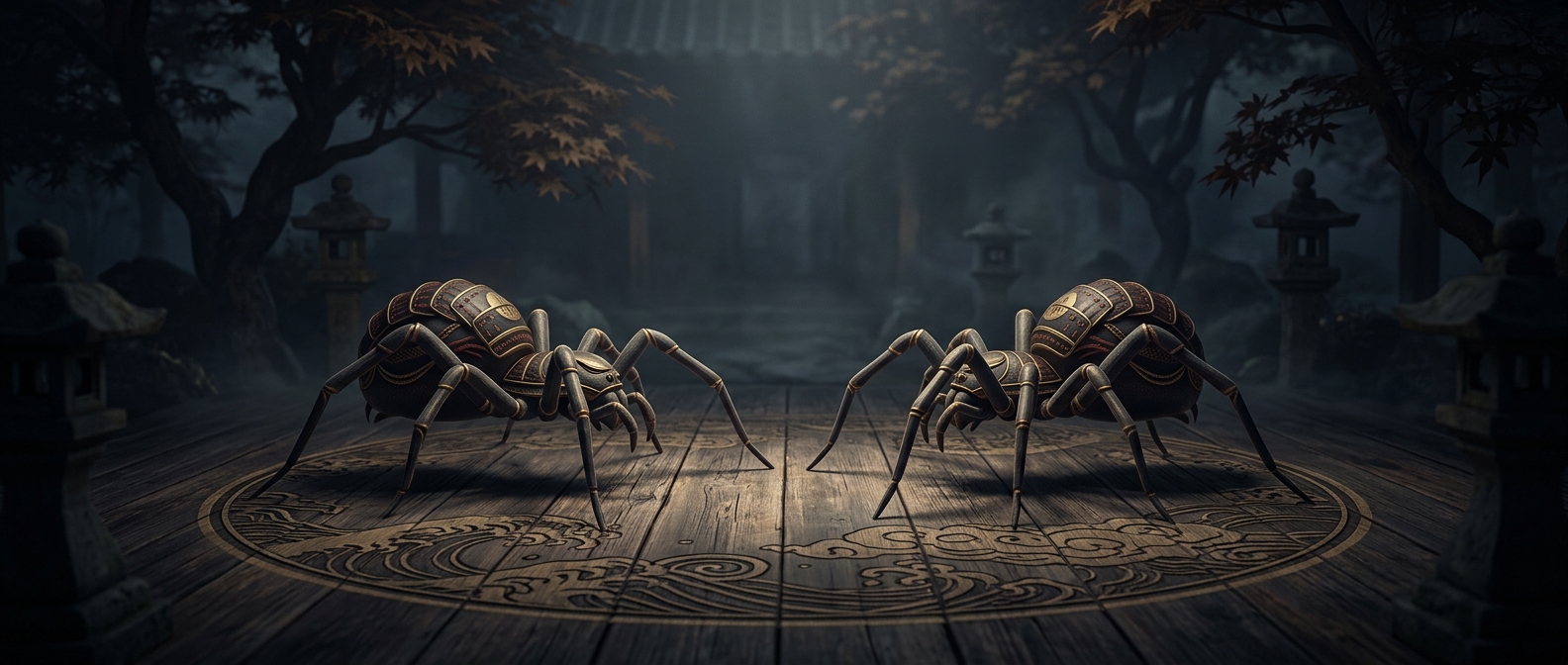
A contest built around a spider’s natural tools
Kajiki’s Kumo Gassen turns the way spiders hunt and defend themselves into a close-up contest. Two female spiders meet on a narrow wooden stick, where there is little room to retreat. A referee watches for a clear outcome: one may bite, bind the other with silk, or drive her off the perch.
The stick is more than a miniature arena. Its narrow surface makes each movement visible and gives the encounter a simple boundary: hold your place, or lose it. Silk, usually associated with webs, becomes a practical tool for controlling an opponent; a bite can also end the struggle. The referee’s presence makes those actions legible as a match rather than an indistinct tangle.
A local tradition made visible
The festival is known as Kumo Gassen, or “spider battle,” and is held in Kajiki, in Kagoshima Prefecture. Its appeal comes partly from scale: the contest is small enough to fit in a hand, yet the stick concentrates attention on every shift, strand, and shove. Instead of watching a spider in a web, spectators see a brief confrontation on an exposed stage.
That format also shapes what makes a contest decisive. The spiders do not need to kill one another for there to be a winner; being forced off the stick counts. The result is a contest in which staying balanced and keeping a foothold can matter as much as attacking—an unusually literal case of the ground beneath a competitor becoming part of the competition.